
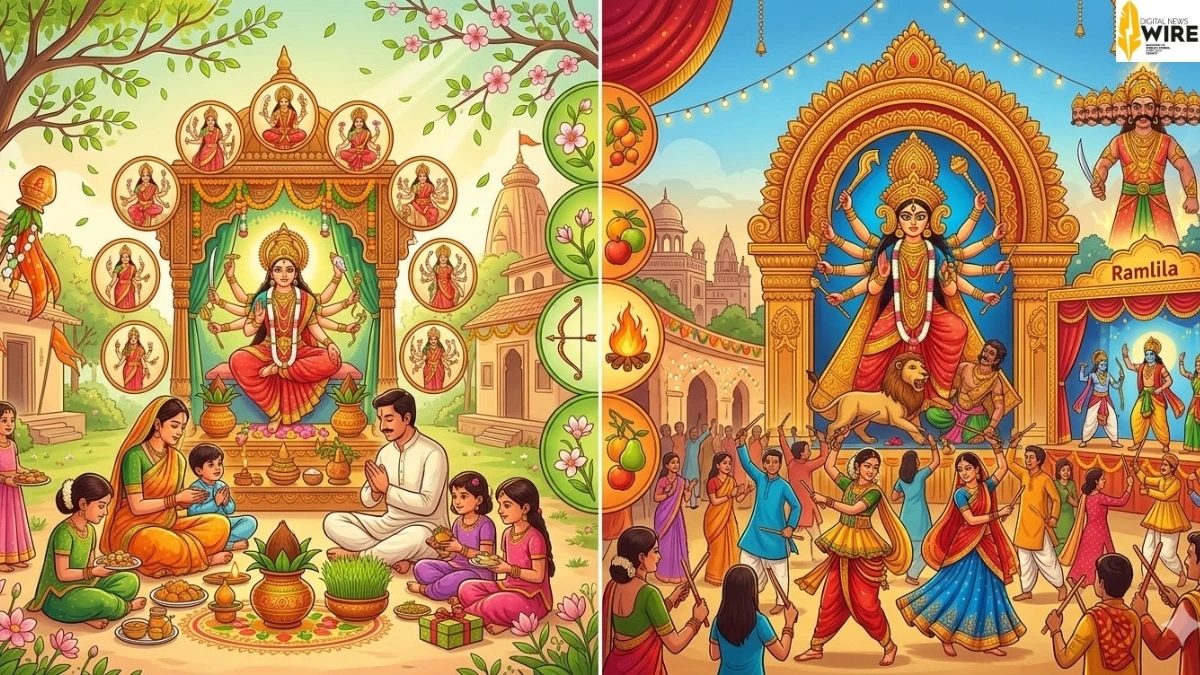
How do Chaitra Navratri and Sharadiya Navratri differ? In this study, find out their timing, meaning, customs, and distinguishing characteristics.
New Delhi: Among Hinduism’s most holy and well-liked holidays is Navaratri. The term nine nights refers nine days devoted to the worship of nine divine forms of Goddess Durga. Many people are unaware, meanwhile, that Navratri is not only once a year. Among all of its events, Chaitra Navratri and Sharadiya Navratri are two stand out the most significantly and are honored several times.
Both celebrations include fasting, the holy rite of Ghatasthapana, and devotion of Maa Durga. Still, they have different timing, spiritual importance, celebration approach, and emotional weight.
Chaitra and Sharadiya Navratri usually fall in?
Falling in the Shukla Paksha of the Hindu month of Chaitra, which matches March–April in the Gregorian calendar, Chaitra Navratri This is Vasant season, or springtime, when nature is in full bloom, new leaves are budding, and the air smells fresh and alive. This is the origin of its alternate moniker, Vasant Navratri or Spring Navaratri.
The Shukla Paksha of the Ashwin month, which occurs in September–October, sees the arrival of Sharadiya Navaratri. This is the Sharad season, the wonderful post-monsoon time when the heavens clear and the weather becomes lovely. Therefore, it is sometimes referred to as Sharad Navratri or Maha Navratri.
Significance of each?
Newly starting and spiritual awakening are at the center of Chaitra Navratri’s essence. In many areas of India, it signals the beginning of the Hindu New Year. The focus at this period is inner cleansing, meditation, and personal renewal—very much like the fresh energy of springtime itself. Furthermore connected to the start of Lord Rama and the establishment of the cosmos is this Navratri.
Sharadiya Navratri, by contrast, is a celebration of divine power and the victory of good over evil. Hindu tradition holds that Goddess Durga fought and killed the demon Mahishasura during these nine days. This Navratri has a more outward, communal energy whereby people come together to honor the strength and elegance of the Mother Goddess.
What is each Navratri’s conclusion?
This is among the main contrasts between the two. On the ninth day, Ram Navami, Lord Rama’s blessed birthday, marks the end of Chaitra Navratri. It is a day of righteousness, devotion, and the start of a fresh spiritual cycle.
On the tenth day with Dussehra (Vijayadashami), Sharadiya Navratri ends. This day honors both Lord Rama’s defeat of Ravana and Goddess Durga’s defeat of Mahishasura. Performances of Ramlila are presented all across India, where statue of Ravana are set Lit to represent the never-ending victory of honesty.
Which areas mark which Navratri?
Particularly well-known in North India, Maharashtra, Andhra Pradesh, Telangana, and Karnataka is Chaitra Navratri. It runs concurrent with regional New Year festivities including Navreh in Kashmir, Gudi Padwa in Maharashtra, and Ugadi in Andhra Pradesh and Karnataka.
Focusing on puja, rigorous fasting, and devotional singing, the festivities during this Navratri are usually more personal and home-centered.
Widely regarded as the largest and most vibrant form of Navaratri, Sharadiya Navaratri is observed with much grandeur everywhere in India. Big Durga Puja pandals are erected and idol immersion parades attract millions in West Bengal, Bihar, Odisha, and Assam.
To the rhythms of Garba and Dandiya, Gujaratis dance all night. With much fanfare, Ramlila and Dussehra festivities in North India signal its end.
What points do both Navratri’s share?
Though they vary, Navratris have a lovely common thread:
- Both cover nine days of worship of the nine forms of Goddess Durga—Shailputri, Brahmacharini, Chandraghanta, Kushmanda, Skandamata, Katyayani, Kalaratri, Mahagauri, and Siddhidatri.
- Both start on the first day with Ghatasthapana, the holy installation of the Kalash.
- One sees everyday aarti, bhajans, and Kanya Pujan, which is the worship of young girls as embodiments of the Goddess in both.
- Both celebrations call for fasting and adoption of a sattvic diet.
Both are great opportunities to engage with the divine feminine energy, Shakti, at their center.

