New publications aim to strengthen preparedness among banks, borrowers, MSMEs and financial professionals
New Delhi: With India’s banking sector preparing for the implementation of the Reserve Bank of India’s Expected Credit Loss (ECL) framework from April 1, 2027, the Institute of Cost Accountants of India (ICMAI) has introduced two handbooks offering practical guidance on credit-loss assessment and bank loan restructuring.
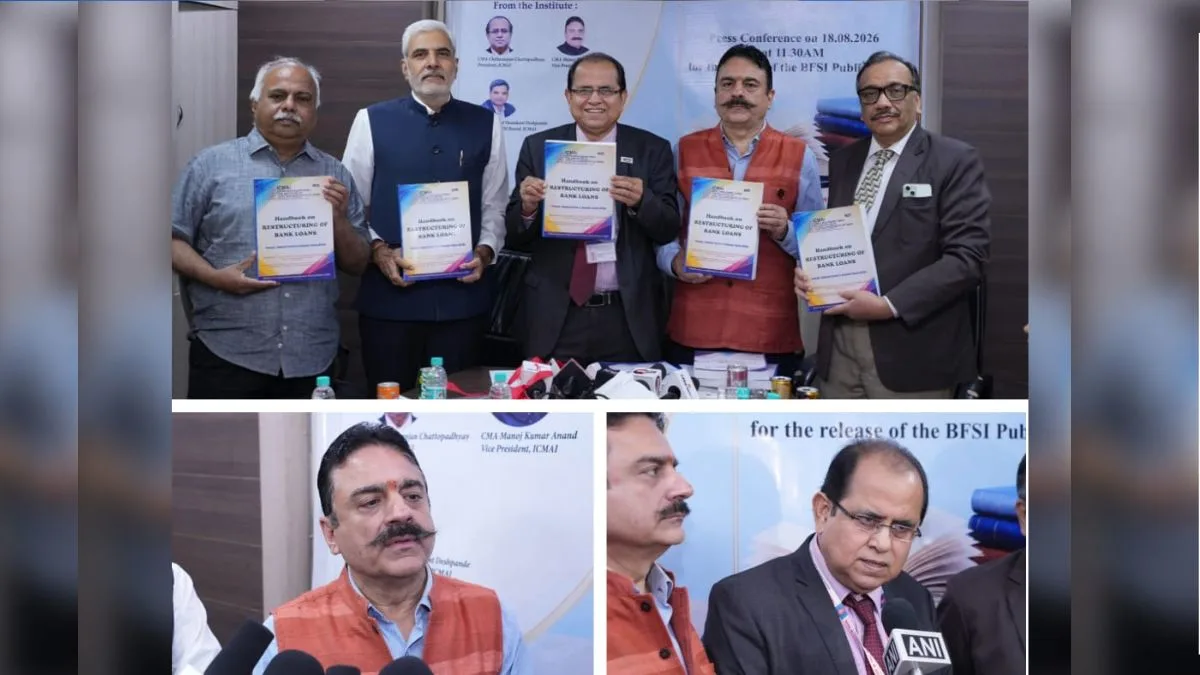
The publications, Expected Credit Loss (ECL) Framework: A Practical Handbook for Indian Banks and Handbook on Restructuring of Bank Loans, seek to serve as practical resources for banks, borrowers, MSMEs, CMAs and other professionals involved in credit and financial management.
The launch was attended by senior ICMAI representatives and banking professionals, including President CMA Chittaranjan Chattopadhyay, Vice-President CMA Manoj Kumar Anand, BFSI Board Chairman CMA Harshad Deshpande, NIPSCOM Director CMA Puneet Jain, author Dr. P. Siva Rama Prasad and former Bank of Baroda Executive Director Dr. Ramjas Yadav. Former Central Bank of India CMD and former IBA Chief Executive CMA M. K. Mohan Tanksale participated virtually.
The ECL handbook provides an overview of the upcoming framework and explains Stage 1, Stage 2 and Stage 3 classifications along with major credit-risk measures such as PD, LGD and EAD.
It further addresses forward-looking macroeconomic information, data management, model development and validation, technology and automation, accounting and auditing requirements, disclosures and strategies for transitioning to the new system. Practical case studies have also been incorporated.
The second publication focuses on the restructuring of bank loans and the management of financially stressed businesses. Its coverage includes early warning signals, evaluation of restructuring proposals, regulatory requirements, financial analysis, TEV studies, financial projections, operating-cost assessment, resolution planning, digital footprint analysis and documentation.
Preparing the banking sector for ECL
CMA Chittaranjan Chattopadhyay said the move towards ECL would be an important development for India’s banking industry and called for timely preparation by banks and other stakeholders.
He said ICMAI’s publications were intended to help professionals understand the practical implications of the framework and adjust to a more forward-looking approach to credit-loss recognition.
Participants at the launch discussed how the ECL framework could encourage banks to identify potential credit losses earlier, thereby improving credit assessment. The need for greater borrower awareness was also emphasised, particularly for businesses dealing with temporary financial stress.
Promoting timely loan restructuring
Dr. P. Siva Rama Prasad said the restructuring handbook was informed by his banking experience and was developed to address gaps in understanding among SMEs, MSMEs and larger businesses seeking restructuring assistance.
He pointed to geopolitical disruptions and the pandemic as factors that have affected business finances and said timely restructuring could help viable enterprises sustain operations and avoid deterioration into NPAs.
ICMAI said the handbook does not seek to replace existing banking procedures. Instead, it aims to help entrepreneurs and borrowers understand the restructuring mechanisms and choices available when repayment difficulties emerge.
Expanding opportunities for Cost Accountants
The programme also focused on the growing contribution of CMAs to the banking and financial services industry.
CMA Manoj Kumar Anand said financial institutions were increasingly seeking cost professionals to improve operational efficiency, control expenses and strengthen profitability.
He noted that CMAs can contribute to credit analysis, risk management, budgeting, cost optimisation, performance evaluation and strategic decision-making in addition to traditional accounting responsibilities.
ICMAI also recommended greater emphasis on cost governance and suggested that banks explore dedicated positions such as Chief Cost Compliance Officer.
Building skills for future banking needs
CMA Puneet Jain said ICMAI had already organised four ECL training programmes and planned further programmes aimed at strengthening professional capabilities.
The institute’s BFSI programmes address credit management, treasury, international banking, concurrent audit and the three principal banking risks—credit, operational and market risk.
As technology becomes increasingly integrated into financial services, ICMAI has also introduced an Advanced Certificate Course on FinTech for graduates and professionals, including MBAs, CAs and CMAs.
The institute said banks and financial institutions were also showing greater interest in recruiting CMAs. Nearly 1,000 placements were recorded through the campus programme over the previous year, with organisations such as ICICI Bank, Cosmos Co-operative Bank, Saraswat Co-operative Bank, Karur Vysya Bank, Power Finance Corporation, IREDA, Shriram Finance, Bajaj Finserv, HSBC Bank and CSB Bank participating.
ICICI Bank recruited more than 250 CMA professionals, while Cosmos Co-operative Bank hired over 80. The highest CTC stood at ₹36 lakh per annum, with average CTCs ranging between ₹12 lakh and ₹14 lakh.
ICMAI said the trend demonstrated increasing opportunities for CMAs in financial management, cost governance, credit assessment, risk management and strategic functions.
The launch served as a platform for banking, professional education and financial-sector stakeholders to discuss preparations for ECL implementation, effective restructuring of stressed loans and the evolving role of CMAs in India’s financial system.
ICMAI said improved credit assessment, stronger cost governance and timely restructuring of viable businesses could collectively contribute to greater financial stability and resilience in the banking sector.