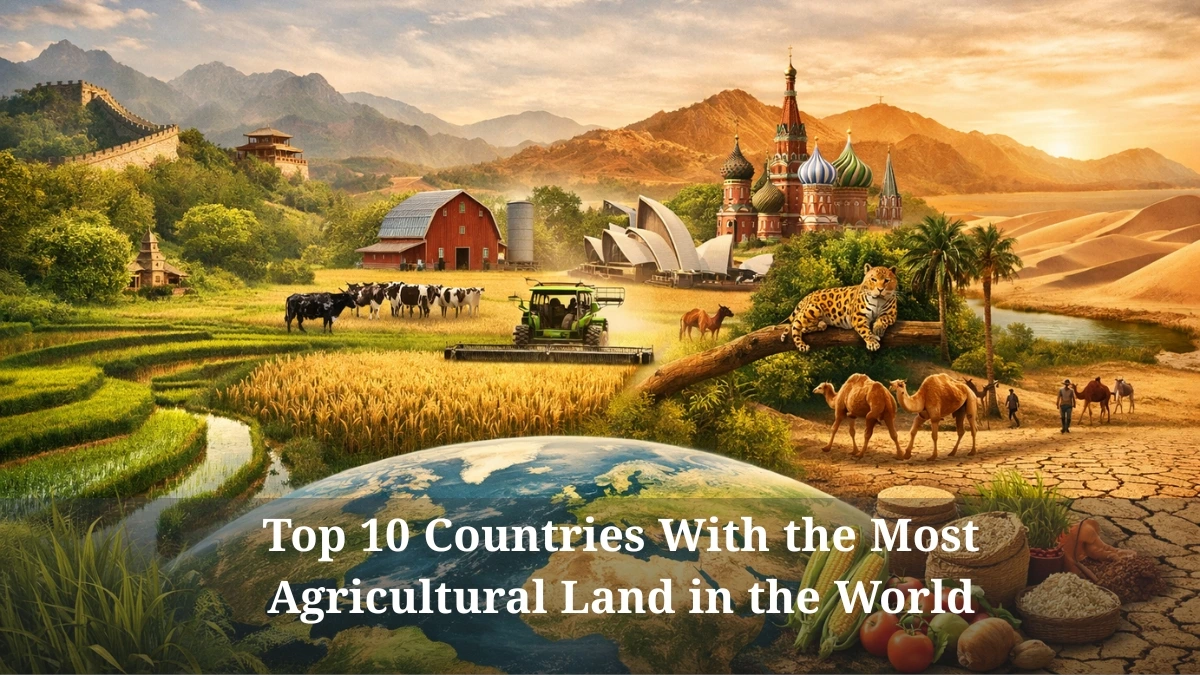
From China’s massive farmlands to Saudi Arabia’s desert pastures, discover which 10 countries control the world’s largest shares of agricultural land — and why it matters for your food plate.
New Delhi: When you sit down to eat rice, wheat, or beef, chances are that food traveled from one of just a handful of countries that dominate the world’s agricultural landscape. According to the latest 2023 data from the Food and Agriculture Organization (FAO) of the United Nations — compiled by the World Bank — our planet has over 48 million square kilometers (roughly 18 million square miles) of agricultural land. That covers more than one-third of Earth’s entire land surface.
But here’s the thing: that land is not spread evenly. A small group of nations holds a staggering share of it, and some of the names on the list will genuinely catch you off guard.
China Leads the World — And It’s Not Even Close
Most people picture China as a country of skyscrapers and megacities. But behind all that urban density lies a farming giant unlike any other.
China tops the global ranking with approximately 2,009,326 square miles of agricultural land — more than the next two countries combined in many comparisons. From the rice paddies of the south to the wheat fields of the north, China’s agricultural reach is extraordinary. Add in its massive livestock sector and vegetable production, and you begin to understand how it feeds 1.4 billion people while still exporting to the world.
The United States and Australia Follow — But for Very Different Reasons
The United States comes in second at 1,627,576 square miles, powered largely by its legendary Corn Belt and soybean-growing regions in the Midwest. American agriculture is industrial in scale, highly mechanized, and deeply tied to global commodity markets.
Australia ranks third at 1,402,492 square miles — a number that surprises many, given how much of the continent is desert. The answer lies in rangelands: vast, semi-arid stretches used for grazing sheep and cattle that technically count as agricultural land. It’s a reminder that “agricultural land” is a broader category than most people assume.
The Full Top 10 at a Glance
| Rank | Country | Agricultural Land (sq miles) |
|---|---|---|
| 1 | China | 2,009,326 |
| 2 | United States | 1,627,576 |
| 3 | Australia | 1,402,492 |
| 4 | Brazil | 914,131 |
| 5 | Russia | 832,826 |
| 6 | Kazakhstan | 827,284 |
| 7 | India | 689,466 |
| 8 | Saudi Arabia | 670,418 |
| 9 | Argentina | 448,405 |
| 10 | Sudan | 435,002 |
The Surprises on the List — Kazakhstan, Saudi Arabia, and Sudan
This is where it gets genuinely interesting.
Kazakhstan, Saudi Arabia, and Sudan in the top 10? For many readers, that raises an eyebrow. These aren’t countries you associate with lush green farmland — and you’d be right to question it. Their rankings are driven almost entirely by massive grazing pastures and rangelands, much of it in arid or steppe environments where crops could barely survive.
This distinction matters. If the ranking were based purely on arable land — soil actually capable of growing crops — the table would look dramatically different. India and the United States would likely surge toward the top, while pasture-heavy nations would fall sharply. Saudi Arabia’s desert grazing land and Kazakhstan’s sweeping steppes are counted, but they represent a very different kind of agricultural capacity than a wheat field in Punjab or a cornfield in Iowa.
Asia and Africa Are Quietly Dominant
If you look at the 50 countries you will see that Asia and Africa are in most of them. Asia and Africa together make up a portion of the list. This is because Asia and Africa are big.. It is also because farming is very important to people in Asia and Africa. Lots of people in Asia and Africa are smallholder farmers. These smallholder farmers, in Asia and Africa need the land to survive. The land is not something they own it is what they need to live. Asia and Africa have hundreds of millions of these smallholder farmers who depend on the land for everything.
What is Agricultural Land Rankings
This isn’t just a geography lesson. The countries that control the most agricultural land effectively set the terms for global food supply — and increasingly, global politics.
Nations like China, the United States, and Brazil dominate world commodity markets precisely because of this land advantage. But with that power comes serious responsibility — and serious problems. Brazil faces relentless pressure to clear more of the Amazon and Cerrado for farmland. Australia battles crippling water scarcity across its rangelands. Saudi Arabia is essentially farming in a desert, drawing on depleting groundwater reserves.
Soil degradation, overgrazing, and erosion are silently eating away at productive capacity in many of these top-ranked nations. The land may be vast, but it is not invincible.
Climate Change Could Redraw the Entire Map
Here’s the long game: climate change may fundamentally shift which countries hold agricultural power in the coming decades.
Rising temperatures will make some new places good for farming. This will happen in Canada and Russia, where the land was frozen before. Now the land in Canada and Russia will be good for farming for the time.
On the hand things are not good for the Sahel region of Africa. The desert in the Sahel region of Africa is getting bigger. This means the land that people use for farming in the Sahel region of Africa will be gone. A lot of people depend on this land for farming, in the Sahel region of Africa.
The gSlobal total of roughly 4.8 billion hectares of agricultural land is, at the end of the day, a finite resource. As populations grow, diets shift toward more meat-intensive food systems, and climate patterns become less predictable, how the world manages this land will determine whether everyone gets to eat.
The Bottom Line
The worlds agricultural land is mostly owned by a few countries. China, the United States, Australia, Brazil and Russia are the biggest ones.
It is not just about how much land they have.
The kind of land they have how good it is for growing things how well it can handle climate change. How well they take care of it are all very important too.
This information from the FAO and the World Bank is telling us something the countries that take good care of their agricultural land now will be very powerful later on. They will have control, over food, water, trade and even peoples lives.
The countries that manage their land wisely today will hold enormous power tomorrow. Over food, water, trade and human survival itself.