India aims to become a developed nation by 2047, but learning gaps, teacher quality and education outcomes may determine its success
10 June 2026, New Delhi:
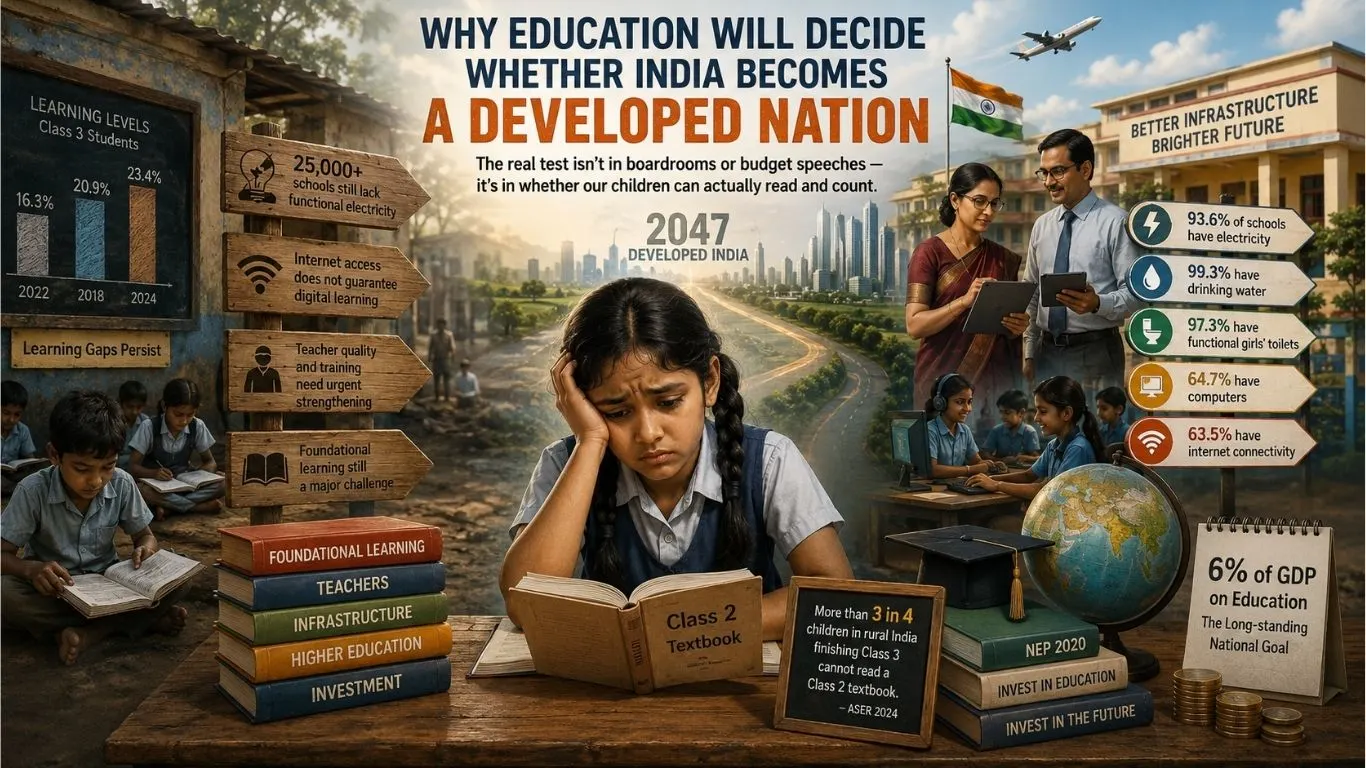
India wants to become a developed nation by 2047. Yet according to ASER 2024, more than three in four children completing Class 3 in rural India still cannot read a Class 2-level text. The gap between these two realities may be one of the country’s biggest long-term challenges.
The infrastructure is improving, the budgets are growing, and policy ambitions are expanding. But what children are actually learning in government schools across Bihar, Jharkhand, Uttar Pradesh, and dozens of other states tells a different story. And that story will matter more than any budget speech when 2047 arrives.
“Human capital accounts for roughly 60–70% of a country’s overall wealth — far more than roads, airports, or industrial corridors.” — World Bank Human Capital Project.
The Money Is Moving. But Is It Enough?
In the Union Budget 2026–27, the Ministry of Education received ₹1.39 lakh crore, an 8.27% increase over the previous year and the highest allocation in its history. Of this, ₹83,562.26 crore was earmarked for the Department of School Education and Literacy.
The government described it as a Yuva Shakti budget. Yet education’s share of total government expenditure remains around 2.6%, while public spending on education is still below the long-standing 6% of GDP target reiterated in multiple education policies.
Countries India explicitly aspires to rival — South Korea, Singapore, Finland — treated education not as a social obligation but as a core economic investment. They funded it accordingly, and they built the knowledge economies that are now the envy of the developing world.
Infrastructure: Better, But Not Enough
The UDISE+ 2024–25 report, published by the Ministry of Education in August 2025, points to significant improvements in school infrastructure across India. Electricity access has risen to 93.6% of schools, nearly all schools now have drinking water facilities and functional girls’ toilets, while access to computers and internet connectivity has continued to expand.
These gains represent meaningful progress. Yet infrastructure gaps remain. More than 25,000 schools still lack functional electricity, and internet connectivity alone does not guarantee effective digital learning. In many rural schools, access to devices, reliable power, and adequately trained teachers continues to lag behind connectivity statistics.
What Children Are Actually Learning
The ASER 2024 survey, which reached 6.49 lakh children across 605 rural districts, is the most comprehensive measure of what Indian children can actually do — not just whether they are enrolled. According to ASER 2024, 23.4% of Class 3 students could read a Class 2-level text in 2024. That figure was 16.3% in 2022 and 20.9% in 2018. The 2024 number is the highest ASER has recorded for government schools since the survey began in 2005.
Arithmetic shows a similar pattern. According to ASER 2024, 33.7% of Class 3 students could do basic subtraction — up from 25.9% recorded in 2021. While the trend is encouraging, the figures also highlight the scale of the remaining learning gap.
Children who fall behind in primary school face compounding disadvantages at every level that follows. The cost of not fixing this is not abstract — it shows up in employability, productivity, and ultimately in whether India’s demographic dividend becomes an asset or a liability.
The Teacher in the Room
Learning outcomes ultimately depend on what happens inside the classroom, making teachers the most critical link between policy ambitions and student achievement. According to UDISE+ 2024–25, India’s total teacher count crossed one crore for the first time — a milestone. Pupil-teacher ratios have improved at every level.
These are positive trends. But quantity and quality are different things, and it is quality where the system strains. Many teachers across India, particularly in low-performing states, lack adequate training in foundational literacy and numeracy instruction.
The NEP 2020 calls for rigorous, continuous professional development for teachers. While teacher numbers have improved, the quality and consistency of teacher training remain key concerns, particularly in states that continue to struggle with learning outcomes
Higher Education: Progress With Caveats
According to the All India Survey on Higher Education (AISHE) 2021–22, released by the Ministry of Education in early 2024, India’s Gross Enrolment Ratio in higher education reached 28.4% for the 18–23 age group — up from 23.7% in 2014–15. The growth has been consistent year on year.
The gender story is particularly notable. Female GER reached 28.5% in 2021–22, exceeding male GER for the fifth consecutive year. India’s Gender Parity Index in higher education now stands at 1.01, according to AISHE 2021–22 — meaning women are, on aggregate, more likely than men to be enrolled.
The concern is quality. India’s higher education system has expanded rapidly in the number of institutions, but research output, industry linkages, and graduate employability have not kept pace across much of the sector. The NEP 2020 targets a GER of 50% by 2035. Whether that expansion comes with genuine quality improvement is the question that will determine whether it translates into economic value.
The Challenges Ahead
Despite gains in infrastructure, enrolment, and funding, persistent structural challenges continue to shape India’s education system. Public spending on education remains below long-standing national targets, while foundational literacy and numeracy continue to lag behind expectations in many parts of the country. Gaps in teacher training, uneven digital access, and sharp disparities between states further complicate the picture.
At the same time, the success of ambitious reforms such as the National Education Policy 2020 will depend less on policy design and more on implementation, funding, and measurable outcomes. How effectively these challenges are addressed over the coming years may ultimately determine whether India’s demographic advantage translates into long-term economic growth.
The Arithmetic of 2047
The children who will form India’s workforce in 2047 are in primary school right now. What they learn, or fail to learn, in the next few years will determine what India actually becomes; regardless of what any policy document says it will become.
The budget is growing. Infrastructure is improving. Policy ambitions are becoming more expansive. Yet the most important measure of progress remains stubbornly unchanged: too many children are still leaving primary school without foundational learning skills. If India hopes to realise its 2047 vision, the transformation must begin where every developed nation ultimately invested most — inside the classroom.