India’s history is shaped by turning points. Explore the books that uncover the ideas, conflicts and events that transformed the country
New Delhi: India cannot be understood through headlines alone. Every political debate, economic reform, social conflict, war, and institutional change we see today has a history behind it. The India of 2026 was shaped not by one event, or one leader, but by decades of movements, conflicts, compromises, and decisions.
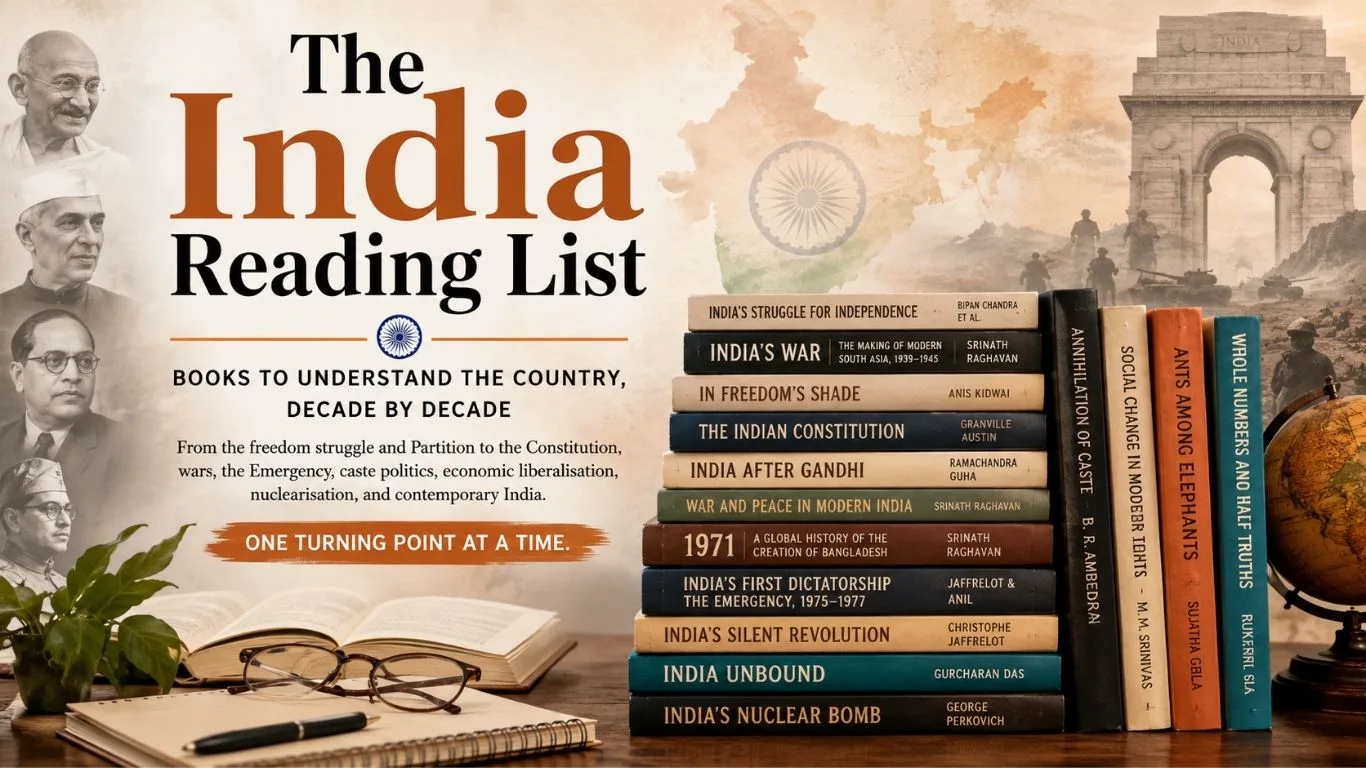
So, if you want to understand India beyond the daily news cycle, start with the books that explain how we got here — from the freedom struggle and Partition to the Constitution, wars, the Emergency, caste politics, economic liberalisation, nuclearisation, and the social changes shaping India today. Here’s a reading list to help you understand India — one turning point at a time.
1. Before Independence: The Freedom Struggle
India’s Struggle for Independence — Bipan Chandra, Mridula Mukherjee, Aditya Mukherjee et al.
One of the most widely used academic accounts of the Indian national movement. It traces the freedom struggle from the Revolt of 1857 through the emergence of organised nationalism, the Gandhian mass movements, revolutionary politics, and the final years of British rule. It is particularly useful for understanding that independence was not the result of one movement or one leader, but of several political and social forces working across decades.
Hind Swaraj — Mahatma Gandhi
Written in 1909, Gandhi’s Hind Swaraj is a short but important text on his ideas about civilisation, modernity, political freedom, and self-rule. Gandhi argues that independence should mean more than simply replacing British rulers with Indian ones. It provides an essential perspective on the philosophical foundations of Gandhian politics.
The Indian Struggle, 1920–1942 — Subhas Chandra Bose
Bose’s own account of the nationalist movement offers a perspective that differs from the more Congress- and Gandhi-centred narratives of the freedom struggle. It is particularly useful for understanding Bose’s political thinking and his disagreements with the dominant leadership of the Congress.
2. The War That Changed the Road to Independence
India’s War: The Making of Modern South Asia, 1939–1945 — Srinath Raghavan
The Second World War fundamentally changed India’s political and economic circumstances. Raghavan examines how the war affected the British Empire, the Indian economy, the armed forces, nationalist politics, and the eventual transfer of power. The book helps explain why the years between 1939 and 1945 were so important in creating the conditions that eventually made British rule increasingly difficult to sustain.
3. Partition: The Human Cost of 1947In Freedom’s Shade — Anis Kidwai
Kidwai’s memoir provides a deeply personal account of the violence and displacement surrounding Partition. Her experiences in refugee relief work in Delhi reveal the human consequences of political decisions: families separated, communities displaced, women facing violence, and ordinary people attempting to rebuild their lives.
Midnight’s Furies: The Deadly Legacy of India’s Partition — Nisid Hajari
Hajari examines the violence surrounding Partition and its long-term consequences for India and Pakistan. The book also connects the events of 1947 to the political relationship between the two countries that followed. Together with personal accounts such as Kidwai’s, it helps show that Partition was not merely a change of borders but a profound human and political rupture.
4. Making the Republic: The Constitution
The Indian Constitution: Cornerstone of a Nation — Granville Austin
A foundational work for understanding how India’s Constitution came into existence. Austin examines the debates and compromises surrounding fundamental rights, federalism, social reform, minority safeguards, and the structure of the new republic. It helps explain why the Constitution was designed in the way it was.
Constituent Assembly Debates — Government of India
For anyone who wants to go directly to the primary sources, the Constituent Assembly Debates are indispensable. They record the arguments of the members who debated questions of citizenship, rights, federalism, language, representation, minorities, and the powers of the state between 1946 and 1949. They reveal that many of the issues India debates today were already being argued at the birth of the Republic.
5. After Independence: Building a New India
India After Gandhi: The History of the World’s Largest Democracy — Ramachandra Guha
One of the most accessible broad histories of independent India. Guha covers Partition, Nehru’s years, linguistic reorganisation, wars, political movements, the Emergency, regional politics, caste mobilisation, economic change, and the evolution of Indian democracy. The revised edition extends the narrative further into contemporary India.
The Idea of India — Sunil Khilnani
Rather than offering a conventional chronological history, Khilnani explores the political and intellectual ideas behind modern India. Democracy, citizenship, secularism, pluralism, economic development, and the tension between unity and diversity are central themes. It is especially useful for thinking about what the Indian state was intended to become after independence.
6. 1962: The War That Changed India’s Strategic Thinking
War and Peace in Modern India: A Strategic History of the Nehru Years — Srinath Raghavan
The 1962 India-China war is often remembered simply as a military defeat. Raghavan places it within the larger context of Nehru-era foreign policy, diplomacy, defence planning, and international politics. The book helps explain how India’s strategic thinking evolved before and after the conflict and why the war became such a major turning point in Indian defence policy.
7. 1971: The War That Redrew South Asia
1971: A Global History of the Creation of Bangladesh — Srinath Raghavan
The creation of Bangladesh was not simply an India-Pakistan conflict. It was also connected to the Cold War and the competing interests of major international powers. Raghavan presents the 1971 war as a global crisis involving India, Pakistan, the United States, the Soviet Union, China, and the people of East Pakistan. Understanding 1971 is essential to understanding the political and strategic balance of South Asia.
8. The Emergency: India’s Democratic Crisis
India’s First Dictatorship: The Emergency, 1975–1977 — Christophe Jaffrelot and Pratinav Anil
The Emergency remains one of the most important crises in the history of Indian democracy. This book examines how political institutions, politicians, bureaucrats, and other interests contributed to the concentration of power and the suppression of democratic freedoms between 1975 and 1977.
9. The Rise of Backward-Caste Politics: The Mandal Moment
India’s Silent Revolution: The Rise of the Lower Castes in North India — Christophe Jaffrelot
The Mandal Commission and the politics surrounding reservations transformed Indian electoral politics. Jaffrelot examines the longer social and political mobilisation of lower castes in North India and explains how communities that had historically been excluded from political power became increasingly influential. The book is useful for understanding why caste remains central to Indian politics even decades after independence.
10. 1991: The Economic Crisis That Changed India
India Unbound — Gurcharan Das
The 1991 economic reforms marked a major shift away from the licence-permit-control system that had characterised much of post-independence economic policy. Das provides an accessible account of India’s economic transformation, the crisis that preceded liberalisation, and the changes that followed.
India’s Long Road: The Search for Prosperity — Vijay Joshi
Joshi looks beyond the initial reforms and asks what India needs for sustained and inclusive economic growth. The book stresses the importance of institutions, productivity, infrastructure, human capital, and state capacity. It is useful for understanding why economic liberalisation did not automatically solve all of India’s development challenges.
11. India’s Nuclear Transformation
India’s Nuclear Bomb: The Impact on Global Proliferation — George Perkovich
India’s nuclear programme developed over several decades, from early debates about nuclear technology and security to the 1974 Pokhran test and the 1998 nuclear tests. Perkovich examines the political, strategic, and international dimensions of this transformation and how India’s nuclear choices affected its relationship with the global non-proliferation system.
12. Caste and Social Structure
Annihilation of Caste — B.R. Ambedkar
One of the most important texts for understanding caste in India. Ambedkar argues that political democracy cannot survive fully without social equality and directly challenges the foundations of caste hierarchy. It remains essential for understanding debates around caste, equality, representation, and social justice.
Social Change in Modern India — M.N. Srinivas
Srinivas examines how caste and social structures changed under modernisation, democracy, urbanisation, and economic development. His concepts and observations became influential in the study of Indian society and remain useful for understanding how traditional social structures adapt to modern political and economic conditions.
Ants Among Elephants — Sujatha Gidla
This memoir approaches caste through family history and lived experience. Gidla documents how caste influences education, employment, relationships, political participation, and everyday life. It offers a personal perspective that complements more academic works on caste.
13. Understanding Contemporary India Through Data
Whole Numbers and Half Truths — Rukmini S.
Statistics increasingly shape how India understands itself. Employment, poverty, education, crime, health, population, elections, and economic growth are all discussed through numbers. Rukmini S. examines how these statistics should be interpreted and how misleading conclusions can emerge when data is stripped of context. The book is particularly useful for anyone trying to understand the difference between what a number actually tells us and what a headline claims it tells us.
India cannot be reduced to a single story, political ideology, historical event, or economic explanation. Each of these books looks at the country from a different window — political, social, economic, personal, constitutional, or strategic.
Together, they reveal how the India of today was built through arguments, conflicts, compromises, movements, wars, reforms, and ordinary people’s experiences. They also show that many questions dominating public debate today are not entirely new. Questions about caste, federalism, secularism, inequality, economic development, citizenship, national security, and the balance between state power and individual freedom have been part of India’s story for generations.
The goal of this reading list is therefore not to “finish” Indian history. It is to build enough context to ask better questions about the present. Because understanding India is not about finding one neat story. It is about learning how many stories came together to create the country we live in today — and recognising that the story is still being written.