
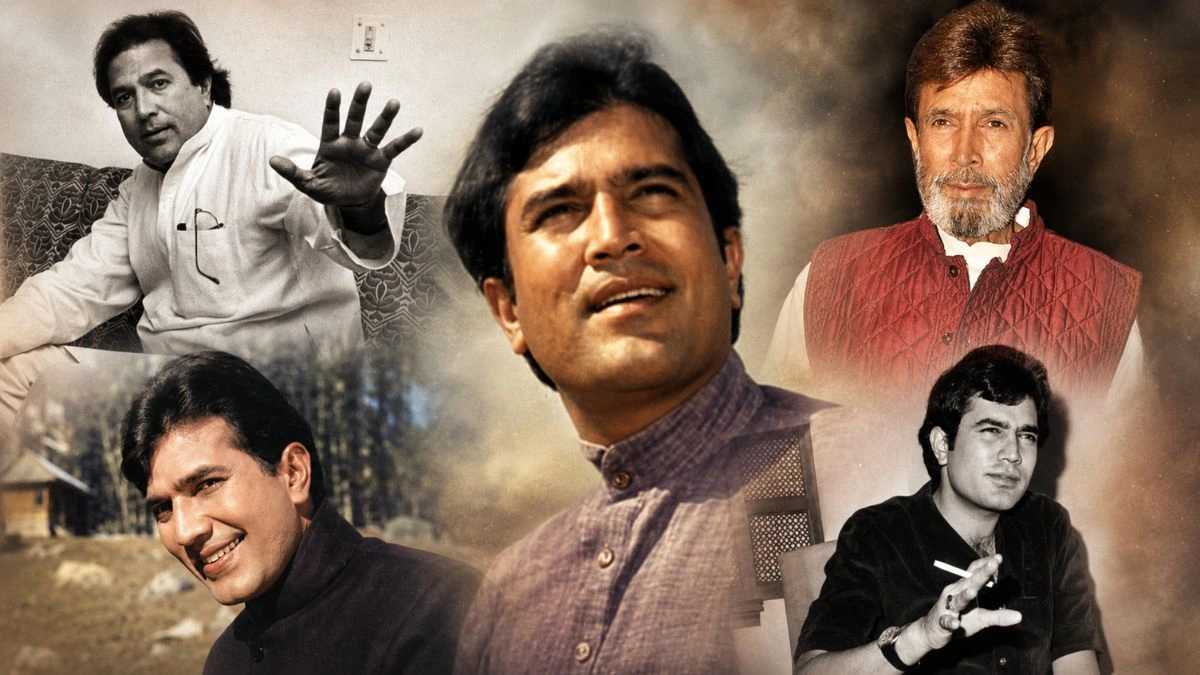
On July 18, Rajesh Khanna’s death anniversary, revisit the life of “Kaka”, his rise with Aradhana, his record run of hit films, his marriage to Dimple Kapadia, and the legacy he left behind in Indian cinema
New Delhi: Every year on July 18, Indian cinema lovers remember Rajesh Khanna, the actor who changed the meaning of stardom in Bollywood. Widely known as India’s first superstar, Rajesh Khanna created a level of fan following that was almost unimaginable. His smile, unique dialogue delivery, emotional performances, and unforgettable songs made him a household name across the country.
Rajesh Khanna passed away on July 18, 2012, at the age of 69, after battling prolonged health issues. Fourteen years later, on his Punyatithi in 2026, his films continue to entertain audiences, proving that true legends never disappear. From romantic classics to emotional dramas, his contribution to Indian cinema remains unmatched.
From Jatin Khanna to Rajesh Khanna
Rajesh Khanna was born Jatin Khanna on December 29, 1942, in Amritsar, Punjab. He was raised by his relatives, Chunnilal and Leelawati Khanna, who later moved the family to Mumbai. It was during his school and college years – he studied at St. Sebastian’s Goan High School and later at K.C. College – that his interest in acting took shape, largely through stage plays.
His big break came in 1965, when he won the All India Talent Contest organised by Filmfare and United Producers, beating out thousands of contestants. That win opened the door to his film debut in 1966 with Aakhri Khat, a film that went on to become India’s official entry for the Best Foreign Language Film category at the Academy Awards.
Film Debut and the Road to Success
Rajesh Khanna made his acting debut in 1966 with Chetan Anand’s Aakhri Khat. Although the film was not a major commercial success, it received critical appreciation and was selected as India’s official entry for the Academy Awards (Oscars) in the Best Foreign Language Film category.
His early films showed promise, but it was only a few years later that destiny transformed him into a national sensation.
‘Aradhana’ Changed Everything
While Aakhri Khat earned him critical attention, it was the 1969 film Aradhana, directed by Shakti Samanta and co-starring Sharmila Tagore, that changed everything.Playing an Air Force officer in a story built around unforgettable music, Khanna became an overnight sensation.
The film became one of the biggest blockbusters of its time, and songs like “Mere Sapno Ki Rani” and “Roop Tera Mastana” became instant classics. Rajesh Khanna’s charming screen presence captured the imagination of millions.
After Aradhana, India witnessed what newspapers and magazines described as “Rajesh Khanna Mania.”
Fans gathered outside his bungalow every day. Young women reportedly wrote him letters in blood, kissed photographs of the actor, and waited for hours just to catch a glimpse of him. His popularity reached a level rarely seen before in Indian entertainment.
Unmatched Run of Hits
Between 1969 and 1971, Khanna delivered a remarkable streak of consecutive hit films – a run so dominant that, according to most film historians, it remains unbroken even today.
Movies like Do Raaste, Kati Patang, Safar, Anand, Haathi Mere Saathi, and Amar Prem ruled the box office one after another. His pairing with actresses like Mumtaz and Sharmila Tagore became iconic, and his films with Mumtaz in particular were commercial gold almost every single time.
Among all his performances, Anand (1971), directed by Hrishikesh Mukherjee, is often considered his finest. Playing a terminally ill man who chooses to live joyfully rather than mourn his fate, Khanna delivered a performance so nuanced that it won him a Filmfare Award and is still studied as one of the great performances in Indian cinema.
Interestingly, several of his most successful films, including Safar and Anand, had his character dying on screen – a pattern that, rather than hurting his box-office appeal, seemed to only add to his emotional pull with audiences.
Over a career spanning more than four decades, Khanna appeared in over 160 feature films and became known as the actor with the most solo-hero films in Hindi cinema at the time, a reflection of just how bankable a name he was on his own, without needing a big co-star to draw audiences.
Why Audiences Loved Rajesh Khanna
Rajesh Khanna wasn’t just a romantic hero. He had the rare ability to express deep emotions with simple facial expressions and natural dialogue delivery. Whether playing a cheerful lover or a terminally ill patient, he made audiences emotionally invested in his characters.
His role in Anand (1971) remains one of Indian cinema’s finest performances. Playing a man battling cancer who chooses to embrace life with optimism, Khanna delivered memorable dialogues that continue to inspire audiences even today.
The famous line,
“”बाबूमोशाय, ज़िंदगी बड़ी होनी चाहिए, लंबी नहीं,”
has become one of Bollywood’s most iconic quotes.
Memorable On-Screen Partnerships
Rajesh Khanna shared remarkable chemistry with several leading actresses.
His pairing with Mumtaz became one of Hindi cinema’s most successful combinations, delivering numerous box-office hits. He also formed unforgettable screen partnerships with Sharmila Tagore, Asha Parekh, Hema Malini, Zeenat Aman, and Moushumi Chatterjee.
His films were equally remembered for their timeless music. Legendary playback singer Kishore Kumar became the voice most closely associated with Rajesh Khanna, while music directors R.D. Burman, S.D. Burman, and Laxmikant-Pyarelal created songs that remain evergreen.
Life Beyond Stardom
Like many film stars, Rajesh Khanna experienced both extraordinary success and difficult phases.
With the emergence of action-oriented cinema in the mid-1970s, led by actors like Amitabh Bachchan, audience preferences gradually changed. Although Khanna continued acting and delivered successful films, the unprecedented craze of his peak years naturally slowed down.
Even then, he remained one of Hindi cinema’s most respected performers and continued appearing in films, television projects, and advertisements.
Marriage and Family
In March 1973, he married a young, upcoming actress named Dimple Kapadia in a wedding that became one of the most talked-about events in the industry at the time, not least because Dimple was still a teenager and had just made her own debut on screen.
The couple had two daughters, Twinkle Khanna, who has since built a successful career as an author and columnist and is married to actor Akshay Kumar, and Rinke Khanna. Rajesh and Dimple separated in 1982 due to differences in temperament, though the two never formally divorced. In his final years, Dimple returned to be by his side and cared for him during his illness.
Political Chapter
In the early 1990s, Khanna stepped into politics, joining the Indian National Congress. He contested the New Delhi Lok Sabha seat in 1992, defeating veteran actor-politician Shatrughan Sinha, and went on to serve as a Member of Parliament until 1996. While politics gave him a new public role, those close to him have often said his real passion never left the world of cinema.
Final Days and Passing Away
Khanna’s health began to decline in his later years, with multiple hospital visits due to weakness and related complications. On July 18, 2012, he passed away at his Bandra residence, “Aashirwad”, a home that had, for decades, been a symbol of his stardom, with fans once lining up outside it just for a glimpse of him.
Thousands gathered despite heavy rain to bid him farewell, and several prominent figures from the film industry attended his funeral. In 2013, the Government of India honoured him posthumously with the Padma Bhushan, the country’s third-highest civilian award.
Awards and National Recognition
Rajesh Khanna’s achievements were recognised throughout his career.
Some of his major honours include:
- Filmfare Award for Best Actor for Sachaa Jhutha (1971)
- Filmfare Award for Best Actor for Anand (1972)
- Multiple Filmfare nominations across four decades
- Padma Bhushan, India’s third-highest civilian award, conferred posthumously in 2013
- Filmfare Lifetime Achievement Award in 2005
He acted in more than 160 feature films and numerous short films and special appearances during a career spanning over four decades.
Rajesh Khanna’s story is one of extraordinary success, immense public love, personal challenges, and lasting influence. His career transformed the idea of celebrity in India and laid the foundation for modern Bollywood stardom.
Even years after his passing, audiences continue to celebrate his films, songs, and unforgettable performances. Every July 18, fans revisit his timeless classics and remember the man whose charm defined an era.
As his legendary dialogue from Anand reminds us:
“Babumoshai, zindagi badi honi chahiye, lambi nahi.”
Rajesh Khanna’s life truly reflected those words. Though his journey was not the longest, it was one of the most remarkable in the history of Indian cinema. His legacy remains immortal, and Bollywood’s first superstar continues to live on in the hearts of millions.


