
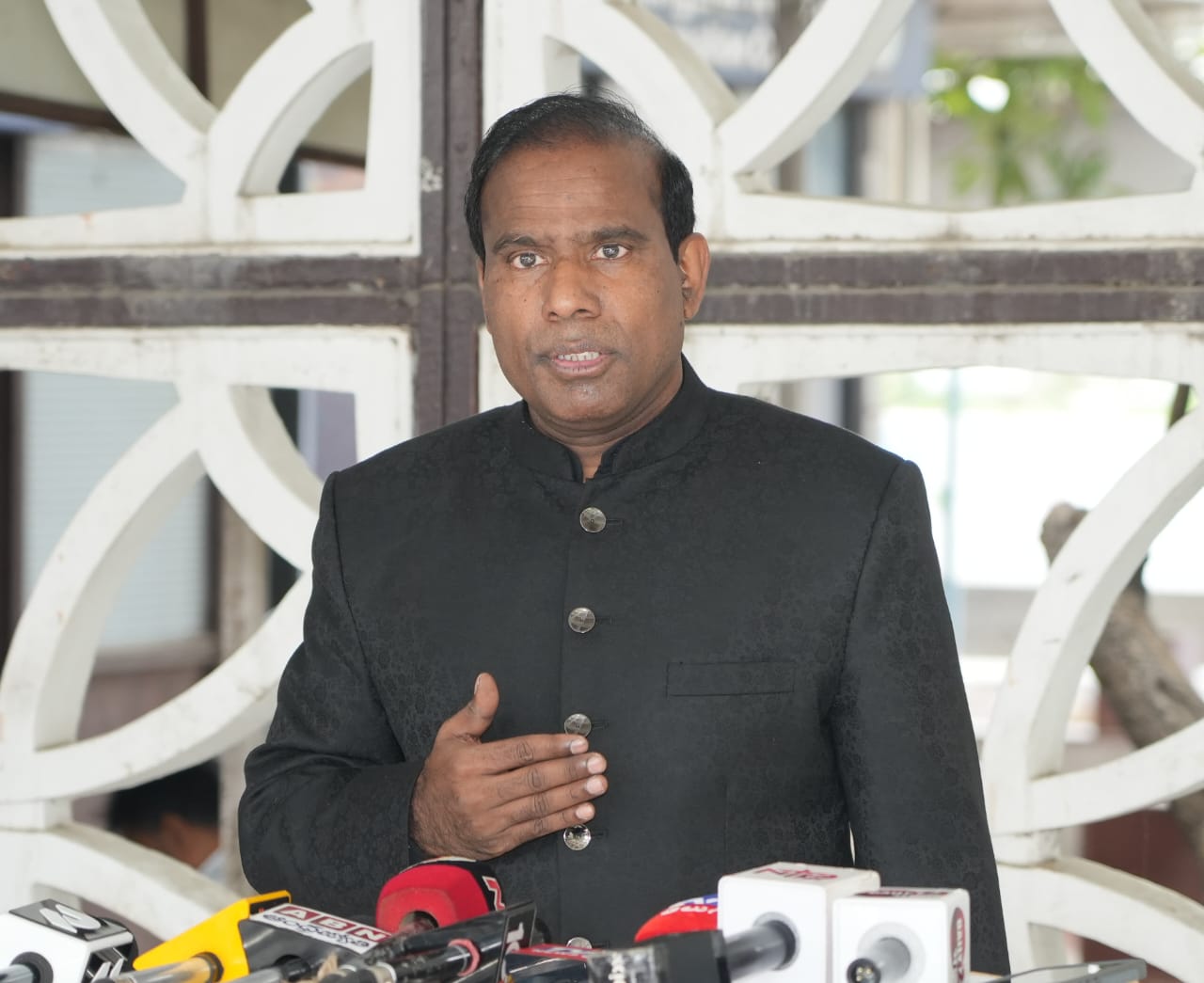
Petition before Justice Surya Kant bench challenges normalization of disrespect toward the judiciary.
New Delhi: An attack on the Chief Justice is an attack on the Constitution,” declared Dr. K.A. Paul, urging the Supreme Court to act firmly against the advocate who threw a shoe at CJI B.R. Gavai and to introduce stronger judicial protection laws.
Dr. Paul’s petition, titled “Justice Now or Never,” was heard today by the bench led by Hon’ble Justice Surya Kant (Item No. 42). The petition raises serious constitutional questions on equality before law, judicial accountability, and the sanctity of the judiciary.
Addressing the media after the hearing at the Supreme Court Media Lawn, Dr. Paul said, “My petition is not about an individual advocate’s act—it is about protecting the dignity of the judiciary. Throwing a shoe at the Hon’ble Chief Justice of India in open court is an attack on the Constitution itself.”
Dr. Paul strongly criticized what he described as “growing normalization” of disrespect towards the judiciary, noting that the concerned advocate had “openly glorified” his conduct in media interviews after the incident.
“If such acts are pardoned and celebrated, they will inspire others to defy the courts,” Dr. Paul warned. “The world is watching how India, the largest democracy, upholds the dignity of its judiciary.”
He further referred to a recent incident in the Jharkhand High Court, where advocate Mahesh Tewari allegedly made threats to a sitting judge, calling it “a dangerous trend that must be checked.”
Dr. Paul thanked Justice Surya Kant bench for acknowledging his concerns and permitting him to submit his preventive recommendations to the Supreme Court Bar Association. He said he had already met SCBA President Vikas Singh and Solicitor General Tushar Mehta to discuss the measures.
“Justice must not be selective. There cannot be one law for advocates or officials and another for citizens,” Dr. Paul said. “If the Constitution fails to protect the judiciary, it fails to protect the nation.”
Dr. Paul’s petition has drawn national and international attention, with global observers viewing it as a test of India’s commitment to equality before law and the sanctity of its constitutional institutions.