
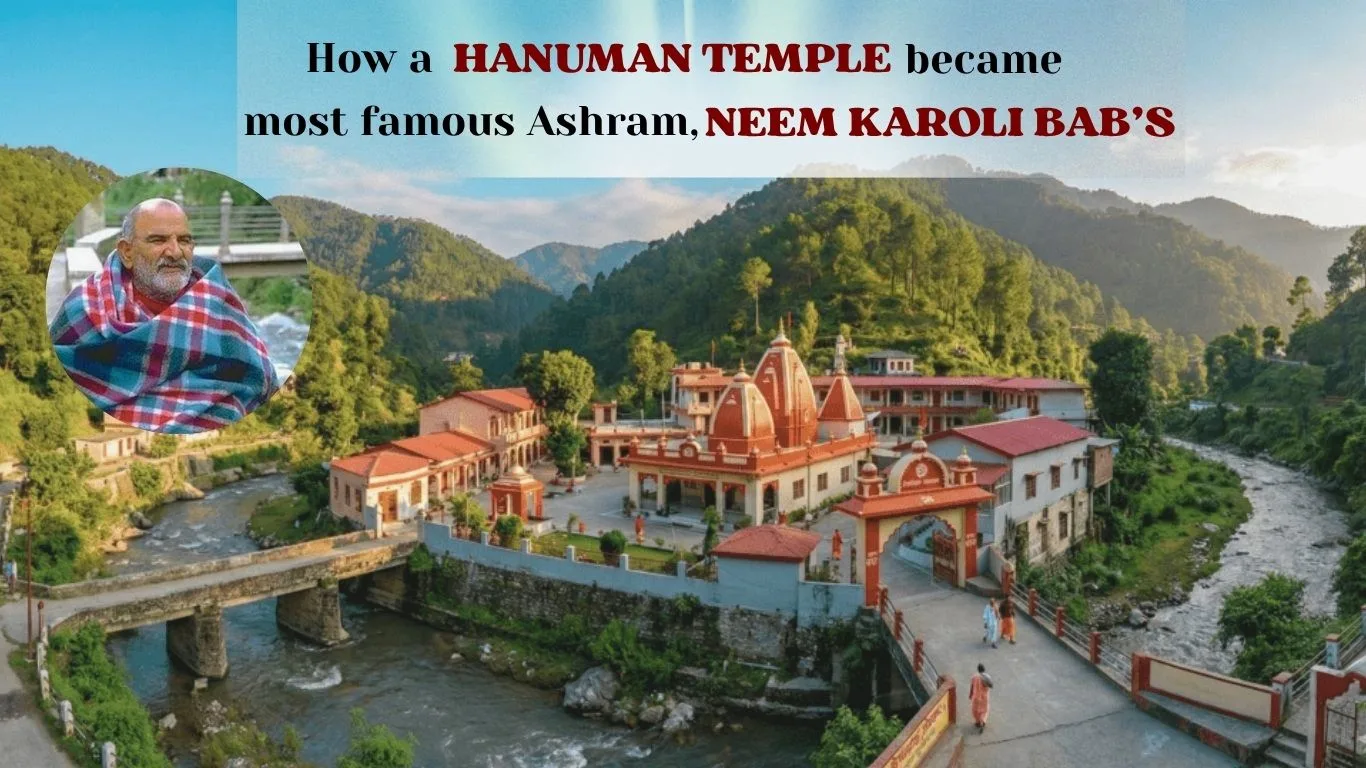
Kainchi Dham Foundation Day 2026: As devotees gather on June 15, here’s the history of how a Hanuman temple became Neem Karoli Baba’s most famous ashram
New Delhi: People around the world know Kainchi Dham as the ashram of Neem Karoli Baba. Every year on June 15, lakhs of devotees gather there, and several well-known global figures have spoken about the place over the years. Yet the site’s story began not with Baba himself, but with a Hanuman temple built on land that already carried a long spiritual legacy.
Who Was Neem Karoli Baba?
Most sources place his birth around 1900 in a village called Akbarpur in Uttar Pradesh, into a Brahmin family. Accounts vary on exactly which district this falls in, with some pointing to Firozabad and others to what is now known as Ambedkar Nagar district. His birth name is generally reported as Lakshman Narayan Sharma, and in his younger years he was also called Lakshman Das.
Following the child-marriage customs of the time, he was married off at around the age of 11. According to most accounts, he left home soon after to live as a wandering sadhu, but his father eventually persuaded him to return, and he settled into married life, fathering two sons and a daughter.
His pull towards renunciation never really left him, though. Around 1958, he is said to have left home again to live as a wandering monk, travelling through northern India under various names, including Handi Wala Baba and Tikonia Wala Baba.
One of the most commonly repeated stories from this period, though people generally treat it as legend rather than verified history — describes him being put off a train without a ticket at a station called Neeb Karori in the Farrukhabad district. The train, the story goes, then refused to move again until railway officials promised to treat wandering sadhus with respect. From that point, he came to be known as Neeb Karori Baba, or Neem Karoli Baba.
When Kainchi Was Just Forest
The story of the ashram itself goes back to 1942, when Neem Karoli Baba met Poornanand, a resident of Kainchi village, and the two of them first talked about building something there. What made the site significant was that it already carried a spiritual history — local accounts say two ascetics, Sombari Maharaj and Sadhu Premi Baba, used to perform yagyas (fire rituals) and meditate there, and Baba apparently wanted to build something in their memory.
About twenty years later, in 1962, Baba returned to Kainchi and sent for Poornanand again. The two recalled their earlier meeting, and decided to look at the exact spot where the two ascetics had once performed their yagyas. The forest was cleared, the land was leased from the forest department, and a rectangular platform was built over the old yagya site.
Building the Hanuman Temple
A temple to Hanuman was raised on this platform, along with a few rooms for the ashram. Neem Karoli Baba is widely regarded as a devoted follower of Hanuman, and many devotees go further and believe he was an incarnation of Hanuman himself. From the very start, then, the heart of Kainchi Dham was devotion to Hanuman.
There’s some inconsistency around the exact founding date. Most accounts place the beginning of construction in 1962, while some sources associate the formal establishment of the ashram with the inauguration of the Hanuman temple in 1964.
What remains consistent across most accounts is that June 15 is observed as the ashram’s foundation day, commemorating the consecration ceremonies associated with the Hanuman temple. On that day, a large mela is held at Kainchi Dham, and local reports suggest that the community feast (bhandara) serves more than a lakh devotees.
From Hanuman Temple to Neem Karoli Baba’s Ashram
In his final years, Neem Karoli Baba spent every summer at the Kainchi ashram. His talks, the seva carried out there, and the personal experiences devotees described all gradually gave the place its own distinct identity.
He passed away in the early hours of September 11, 1973, in a hospital in Vrindavan after slipping into a diabetic coma — though because this happened so close to midnight, some accounts describe it as the night of September 10. After his death, devotees began building a temple for him in 1974 without any formal design or plan, and his murti was later consecrated at Kainchi as well.
Visitors from the West started arriving not long after. Apple co-founder Steve Jobs travelled to India in 1974 with his friend Daniel Kottke and visited the Kainchi ashram during that trip. By then, however, Baba had already passed away, so Jobs never actually met him in person, but the visit still left a deep impression on him and is often cited as an experience that influenced his interest in spirituality and simplicity.
Facebook founder Mark Zuckerberg has also visited Kainchi Dham, reportedly in 2015, and he later said that Steve Jobs himself had advised him to visit the ashram during a difficult period for Facebook. Visits like these helped Kainchi Dham’s reputation spread well beyond India.
The Hanuman Temple Remains the Centre
Even today, the oldest and most prominent temple at Kainchi Dham is the one dedicated to Hanuman. The complex has since grown to include other temples, including one for Lakshmi-Narayan, as well as Neem Karoli Baba’s samadhi. But for devotees, the place has come to represent far more than a Hanuman temple — it now stands for Baba’s presence and his teachings. That’s largely why most people refer to it as “Neem Karoli Baba’s ashram” or simply “Kainchi Dham,” rather than by the name of its original Hanuman temple.