What is ESTIC 2026? Know how India’s science and technology conclave began, why it was formed and what to expect at Bharat Mandapam, New Delhi, from October 27 to 29
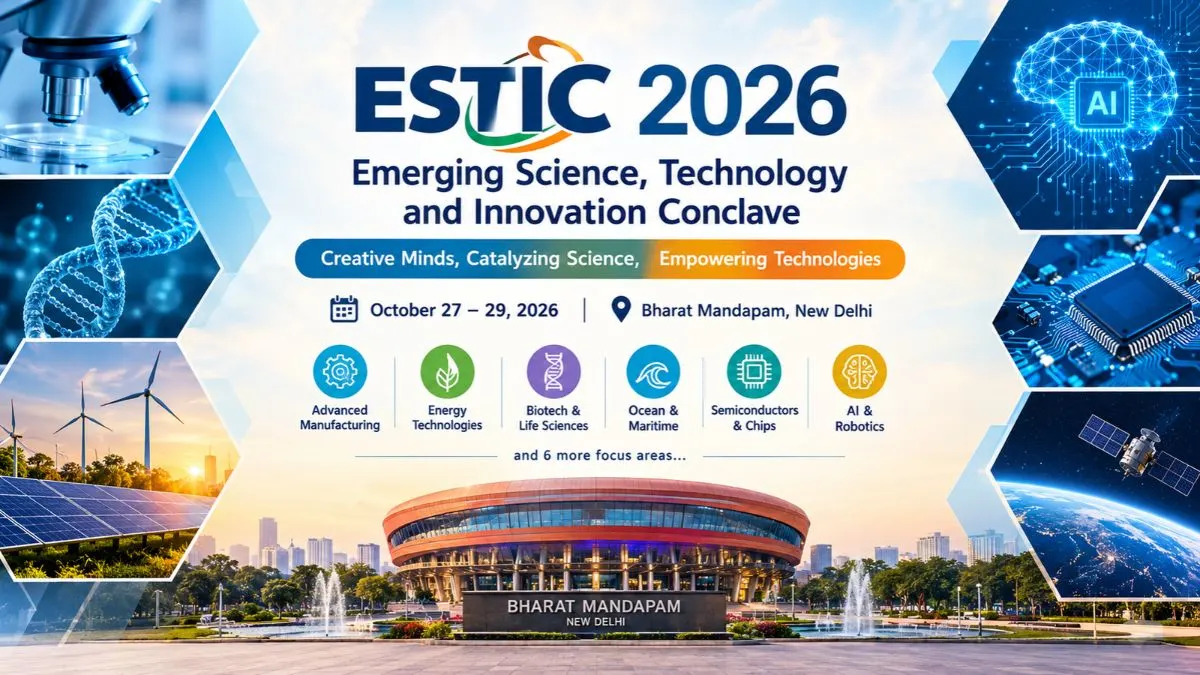
New Delhi: India’s second Emerging Science, Technology and Innovation Conclave (ESTIC 2026) will bring scientists, technology experts, policymakers and startups together to discuss new ideas and research. The three-day event runs from October 27 to 29 at Bharat Mandapam in New Delhi. Prime Minister Narendra Modi will inaugurate the conclave on October 27 at 5:30 PM and address the gathering. The programme will cover 12 areas of science and technology, with discussions on research, innovation and ways to turn scientific discoveries into practical solutions.
What is ESTIC?
ESTIC stands for the Emerging Science, Technology and Innovation Conclave. In simple terms, it is a national platform where researchers, businesses, government representatives and innovators can exchange ideas about new technologies and scientific developments.
The event aims to connect laboratory research with real-world needs. For example, scientists developing advanced medical technologies could meet healthcare companies, while researchers working on clean energy could explore ways to bring their discoveries into wider use.
ESTIC 2026 is the second edition of the conclave. The first edition took place from November 3 to 5, 2025, at the same venue.
Who is organising it?
The Council of Scientific and Industrial Research (CSIR) organises ESTIC 2026 under the guidance of the Office of the Principal Scientific Adviser to the Government of India. CSIR-National Institute for Interdisciplinary Science and Technology (CSIR-NIIST) serves as the organising partner.
The conclave brings together participants from universities, research institutions, public sector undertakings (PSUs), private companies, startups and government bodies. Women entrepreneurs, young scientists and international experts will also take part.
The theme, explained
This year’s theme is “Creative Minds, Catalyzing Science, Empowering Technologies.”
The theme highlights three connected ideas. Creative thinking helps researchers approach difficult problems in new ways. Scientific research tests those ideas and builds reliable knowledge. Technology then helps turn that knowledge into useful products, services and systems.
The focus is not only on making discoveries but also on helping those discoveries reach people. This could mean improving healthcare, developing more efficient manufacturing methods, strengthening communication networks or finding better ways to manage natural resources.
Why the conclave exists
Union Minister of State for Science and Technology Dr Jitendra Singh said organisers conceived ESTIC in 2025 to bring different parts of India’s science and technology ecosystem onto one common platform. The idea was to reduce fragmentation caused by separate events held throughout the year.
Researchers often need industry partners, funding, policy support and specialised technical knowledge to develop their work beyond the laboratory. A shared platform can help these groups find potential partners and discuss common challenges.
At the curtain-raiser event in September 2026, Singh also highlighted the importance of combining scientific expertise with management and communication skills. His remarks pointed to a wider challenge: research needs effective planning, clear communication and industry links to reach its full potential.
The 12 areas of focus
| Focus area | What it means |
|---|---|
| Advanced Manufacturing | Developing smarter, more efficient ways to make products. |
| Energy Technologies | Improving energy generation, storage and use. |
| System and Synthetic Biology | Understanding biological systems and designing new biological functions. |
| Ocean Science and Maritime Technologies | Studying oceans and developing technologies for marine activities. |
| Intelligent Networks and Quantum Communication | Exploring smarter communication networks and quantum-based secure communication. |
| Semiconductors and Next-gen Chips | Developing the chips that power electronics, computing and digital devices. |
| Agri-Tech, Food Systems and Nutrition | Using technology to improve farming, food production and nutrition. |
| Generative and Autonomous AI | Building AI that creates content or performs tasks with less human direction. |
| Autonomous Systems, Physical AI and Robotics | Developing robots and intelligent machines that interact with the physical world. |
| Preventive Medicine and Advanced Healthcare Solutions | Using science and technology to prevent illness and improve treatment. |
| Immersive Tech: Generative XR and Spatial Computing | Creating interactive digital experiences using extended reality and spatial computing. |
| Space Science and Technologies | Advancing space research, exploration and related technologies. |
Some of these terms describe emerging fields. Synthetic biology involves designing or modifying biological systems for specific purposes. Physical AI refers to AI that helps machines understand and act in the real world. XR, or extended reality, covers virtual, augmented and mixed reality technologies that combine digital content with a person’s surroundings.
Three Nobel laureates among the speakers
ESTIC 2026 will feature three Nobel laureates: Prof. Joachim Frank, Sir Richard J. Roberts and Prof. Kostya Novoselov.
Frank shared the 2017 Nobel Prize in Chemistry for developing cryo-electron microscopy methods that allow scientists to study the structures of biological molecules in fine detail. Roberts shared the 1993 Nobel Prize in Physiology or Medicine for discoveries involving split genes, which helped scientists understand how genetic information works. Novoselov shared the 2010 Nobel Prize in Physics for groundbreaking experiments with graphene, an extremely thin form of carbon with unusual electrical and mechanical properties.
Their participation brings expertise from structural biology, genetics and materials science to the conclave. Organisers also expect scientists, industry leaders and other international experts to contribute to the discussions.
The technology exhibition: open to the public from day two
The technology and innovation exhibition will showcase Indian scientific achievements, emerging technologies and deep-tech startups. It will open to the public on October 28, the second day of the conclave.
Deep tech refers to technology built on substantial scientific or engineering advances, rather than simply a new digital service or business model. Examples can include advanced materials, semiconductor technologies, robotics and new biotechnology applications.
Organisers plan to use technology demonstrations, thematic videos, documentaries, information kiosks and augmented and virtual reality experiences to help visitors understand complex subjects. These formats can make scientific developments easier to explore for people without a technical background.
Networking, startups and industry meetings
The programme includes plenary talks, technical sessions, panel discussions, poster presentations and opportunities for young researchers and innovators to present their ideas. Startup presentations and networking activities will also connect researchers with potential industry partners.
The programme includes business-to-business (B2B) and business-to-government (B2G) meetings. B2B meetings help companies explore partnerships with other businesses, while B2G meetings connect businesses with government departments or agencies.
Organisers have also highlighted the Global Connect networking initiative as a way to encourage international research partnerships and closer links between academia and industry. Such meetings can help innovators explore funding, commercial applications and collaboration opportunities.
Looking back: what happened at the first ESTIC in 2025
The first ESTIC took place at Bharat Mandapam from November 3 to 5, 2025, and covered 11 thematic areas.
One major development came when Prime Minister Narendra Modi launched the ₹1 trillion Research, Development and Innovation (RDI) Fund. The initiative aims to encourage private-sector investment in research and development.
Modi also urged India to become more self-reliant in critical inputs. The message highlighted the importance of building domestic capabilities in areas where the country depends on external suppliers. The 2026 edition builds on the effort to bring research, technology development and industry closer together, while expanding the programme to 12 thematic areas.
What to watch over the three days
The main areas to follow include discussions on semiconductors, artificial intelligence, advanced healthcare, energy, biotechnology and space technologies. The exhibition from October 28 will offer visitors a closer look at research and innovations from Indian institutions and startups.
The outcomes will matter as much as the presentations. New research partnerships, stronger industry links and clearer pathways for developing technologies could show how effectively the conclave connects scientific ideas with practical needs.
Readers can check estic2026.in for the official programme, event updates and visitor information.