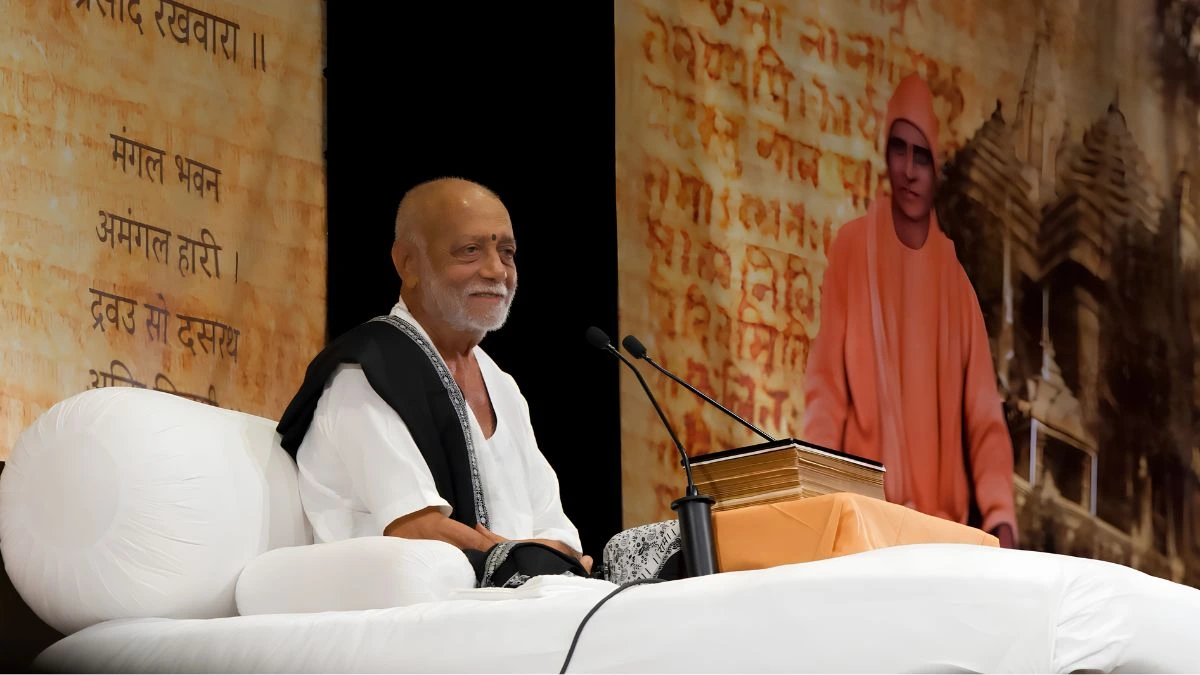
Cambridge, Massachusetts: A nine-day Ram Katha led by Morari Bapu came to an end at Harvard University’s Sanders Theatre on Sunday. Titled Manas Guru Prasad, the programme brought Indian spirituality, literature and classical knowledge into dialogue with scholars and audiences from around the world.
At the closing event, Morari Bapu called on Harvard to preserve copies of the four Vedas, Ramcharitmanas and Valmiki Ramayana. He said keeping these important texts in an academic institution would allow future students and researchers to study India’s rich knowledge heritage.
The event went beyond a traditional spiritual gathering. It aimed to create a connection between India’s classical intellectual traditions and contemporary academic discussions, while introducing global audiences to the literary and spiritual significance of the Ramcharitmanas.
On August 19, the organisers marked Goswami Tulsidas’ birth anniversary with the Tulsi Janmotsav and Global Awards ceremony. The event was notable because the Tulsi, Vyas, Valmiki and Ratnavali Awards were presented outside India for the first time in the 16-year history of the Ram Katha tradition.
Eight awards were presented to nine scholars and cultural contributors. Prof. Sally J. Sutherland Goldman, Prof. Robert P. Goldman and Prof. Madoka Fukuoka were honoured with the Valmiki Award. Prof. John Stratton Hawley, Dr Ashwin Bhai Kantilal Rajgor and Devi Chitralekha received the Vyas Award.
The Tulsi Award went to Prof. Rupert Snell and community leader Piyush Bhai Mehta. Harvard professor Diana L. Eck received the Ratnavali Award for her contribution to the field of comparative religion.
The programme also featured Indian storytellers, scholars, musicians and artists alongside members of Harvard’s academic community. From August 16 to 18, a three-day scholarly dialogue brought together participants from Japan, the Netherlands, the UK and the US to explore different aspects of Indian literature, philosophy and culture.
Reflecting on his presence at Harvard, Bapu said, “I have not come here to study, nor have I come to teach; I have come to distribute prasad.”
The Manas Guru Prasad programme ultimately served as a meeting point for spirituality, scholarship, music and cultural exchange, highlighting India’s classical traditions and universal values of truth, love and compassion.