
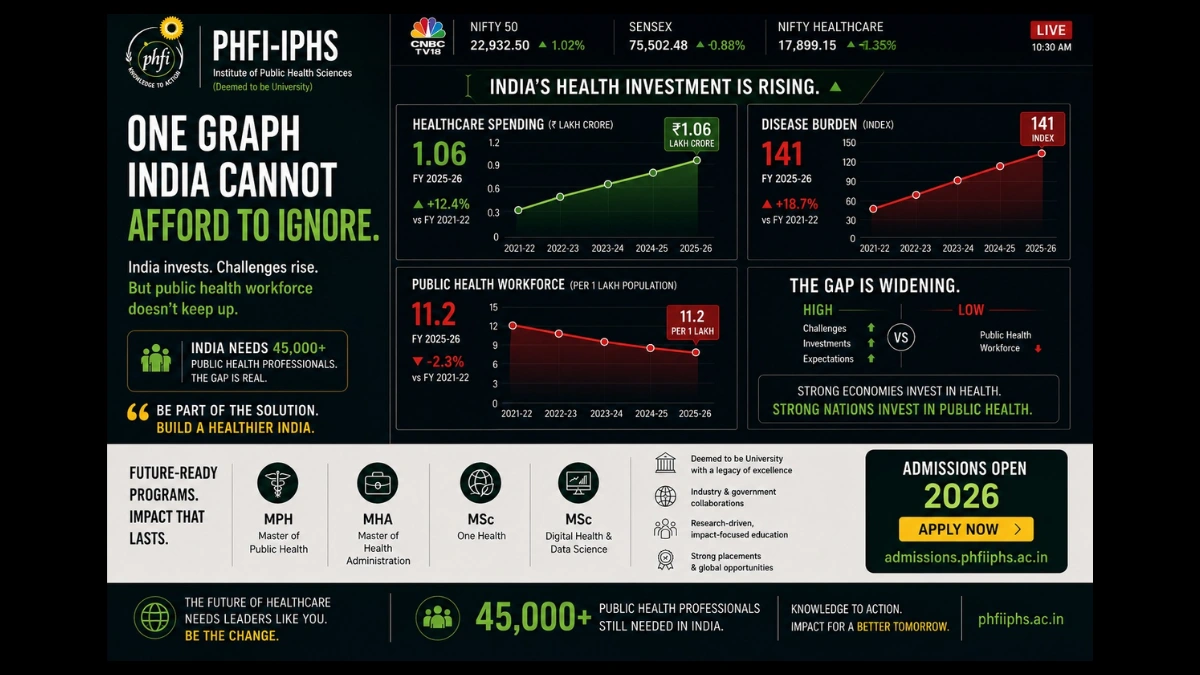
With healthcare spending reaching new heights, PHFI-IPHS believes India’s future depends on preparing skilled public health professionals who can turn policy initiatives into stronger health systems and improved public health outcomes.
Hyderbad: India’s healthcare sector is undergoing a major transformation, backed by significant investments in programs such as Ayushman Bharat, the Digital Health Mission, AI-enabled healthcare, disease monitoring, pandemic preparedness, climate health, and preventive healthcare. While these initiatives are reshaping the nation’s health ecosystem, experts believe that the shortage of trained public health professionals remains one of the biggest challenges to achieving better health outcomes.
According to estimates by the PHFI Institute of Public Health Sciences (PHFI-IPHS), India currently requires more than 45,000 additional public health professionals to support its growing healthcare needs. While investments in healthcare infrastructure and services have increased significantly over the past few years, the availability of trained professionals capable of planning, managing and strengthening public health systems has not kept pace.
Recognising this need, PHFI-IPHS, formerly known as the Indian Institute of Public Health (IIPH), is preparing the next generation of public health professionals through multidisciplinary education, research and practical training.
Recently recognised as a Deemed-to-be University under the Ministry of Education’s Distinct Category of the UGC Regulations, PHFI-IPHS builds on the two-decade legacy of the Public Health Foundation of India (PHFI) in strengthening public health education, research and policy in the country.
“India’s healthcare ambitions require more than infrastructure. They require skilled public health professionals who can strengthen health systems, shape evidence-based policies and improve healthcare delivery. PHFI-IPHS is committed to preparing professionals who can meet these emerging national and global health challenges,” said a representative from PHFI-IPHS.
Healthcare today extends well beyond hospitals and clinical care. The COVID-19 pandemic demonstrated the importance of professionals who can monitor disease outbreaks, analyse health data, design health programmes, develop policies and strengthen healthcare systems before crises emerge.
As healthcare challenges continue to evolve, countries are increasingly investing in epidemiologists, health economists, implementation scientists, public health managers, digital health specialists and policy researchers capable of improving health outcomes at the population level.
India is also entering a period where public health expertise will play an increasingly important role. Rising healthcare expenditure, changing disease patterns, rapid urbanisation, climate-related health risks, ageing populations, antimicrobial resistance and digital transformation are creating new demands on the healthcare system.
Experts say meeting these challenges requires professionals with expertise in disease surveillance, population health, health economics, healthcare management, digital health, public policy, community engagement, implementation research and environmental health.
PHFI-IPHS believes that without this skilled workforce, even the best healthcare infrastructure cannot achieve its full potential.
To help bridge this gap, PHFI-IPHS offers multidisciplinary programmes that reflect the changing nature of healthcare. These include the Master of Public Health (MPH), Master of Health Administration (MHA), MSc in One Health, and MSc in Digital Health & Data Science. The programmes combine epidemiology, health policy, data science, behavioural sciences, management and implementation research to prepare professionals for leadership roles across government, healthcare institutions, international organisations, research agencies and industry.
Beyond academics, the university integrates classroom learning with real-world experience. Students gain exposure to national health programmes, government health systems, community health initiatives, public policy, research projects, digital health technologies and global collaborations, enabling them to understand how healthcare policies are implemented on the ground.
PHFI-IPHS also builds on PHFI’s long-standing contribution to evidence-based policymaking across areas such as non-communicable diseases, maternal and child health, infectious diseases, nutrition, vaccination, health systems strengthening, climate and environmental health, digital health and health financing.
With campuses in Hyderabad, Bengaluru and Bhubaneswar, the university aims to strengthen India’s public health capacity by preparing professionals capable of addressing both current and emerging healthcare challenges.
As India moves towards becoming a global healthcare leader, PHFI-IPHS believes building a strong public health workforce will be as important as expanding hospitals, improving infrastructure and adopting new technologies. Preparing skilled professionals today, it says, will help ensure that healthcare investments translate into better health outcomes for communities across the country.