Discover how an ancient river once interrupted Puri’s Rath Yatra, how Queen Saradha Devi inspired its transformation, and how a 2018 IIT Kharagpur study uncovered scientific evidence supporting centuries-old temple traditions.
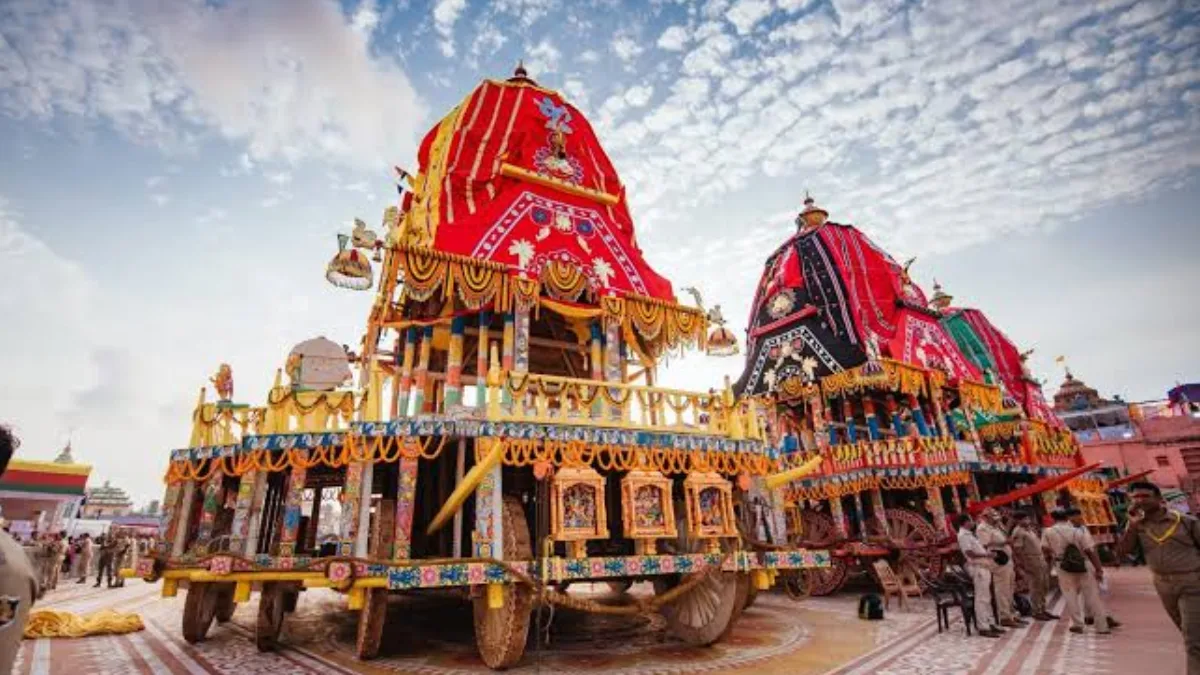
New Delhi: Every year, millions of devotees gather in Puri, Odisha, to witness one of India’s most celebrated religious festivals—the Jagannath Rath Yatra. The sight of Lord Jagannath, Lord Balabhadra, and Devi Subhadra travelling in three massive wooden chariots from the Jagannath Temple to the Gundicha Temple is a symbol of devotion, unity, and tradition.
Today, the journey appears smooth and uninterrupted along Puri’s famous Bada Danda (Grand Road). However, according to temple traditions and historical accounts, this was not always the case. An ancient river once divided the sacred route, making the annual procession far more difficult.
Interestingly, what was preserved in oral traditions for centuries has now found support through modern scientific research. Together, faith, history, and technology tell an extraordinary story of how the Rath Yatra evolved into the grand festival the world witnesses today.
When an Ancient River Divided the Sacred Route
According to Odia temple tradition, a river once flowed through what is now the Grand Road, splitting the town in half and separating the Jagannath Temple from the Gundicha Temple. Old temple records, including the Madala Panji chronicle and a compiled historical text called the Katakarajavamshabali, back this up. Some versions of the story even use the name “Malini” for this river, describing it as a branch of the larger Bhargavi river.
Because of this river, the Rath Yatra used to be a two-part affair. Three chariots would carry the deities from the main temple down to the riverbank. There, the idols were carefully moved onto boats, or across some kind of makeshift crossing, and then loaded onto a second set of three waiting chariots on the far bank. Some old accounts even mention a seventh chariot, possibly used to carry musicians along for the ride.
You can imagine how awkward this must have been, especially during monsoon season, when a swollen river would have made the crossing even riskier. This split-journey system is said to have continued for generations, right up until the reign of Gajapati King Narasingha Deva.
Queen Saradha Devi’s Dream That Changed History
Temple tradition tells us it was the king’s wife, Queen Saradha Devi, who finally put an end to the divided journey. As the story goes, Lord Jagannath appeared to her in a dream one night and asked her to make sure his trip to his aunt’s home at the Gundicha Temple would never again be interrupted.
Taking this seriously, the Queen went to the King, but the royal treasury didn’t have enough money to solve the problem on its own. What happened next is really the heart of the story: ordinary people from across Odisha stepped in. Thousands of them carried sand, load after load, on their shoulders and in their hands, and slowly filled in the river channel by hand. It wasn’t royal engineers or paid laborers alone; it was an entire community pitching in out of devotion.
Once the channel was filled, the site came to be known as Saradha Bali, meaning “Saradha’s sand,” named after the Queen herself. From that point on, the Rath Yatra could be carried out with just one set of three chariots, Nandighosa for Jagannath, Taladhwaja for Balabhadra, and Darpadalana for Subhadra, rolling all the way from one temple to the other without a break.
Why Saradha Bali Remains Sacred
Even today, Saradha Bali holds immense religious importance during the Rath Yatra.
As the chariots arrive near the Gundicha Temple, the deities are ceremonially carried inside the temple through the traditional Pahandi Bije, a ritual in which the Daitapati servitors gently escort the deities in a rhythmic procession.
The sand at Saradha Bali is popularly known as Bajra Dhuli.
Many devotees believe this sacred sand carries divine blessings because it symbolizes the devotion of Queen Saradha Devi and the countless volunteers who worked together to create the pathway.
Pilgrims often collect a small amount of the sand or apply it to their foreheads and bodies as a mark of reverence and faith.
Science Finds Evidence of the Lost River
For generations, the story of the lost river was preserved mainly through temple records and oral traditions. In 2018, however, researchers from IIT Kharagpur presented scientific findings that closely matched these historical accounts.
The research team, which included Subhamoy Jana, William Kumar Mohanty, Saibal Gupta, and other scientists, used advanced remote sensing technologies to study the geology beneath Puri.
Their methods included:
- Satellite image analysis
- Normalized Difference Vegetation Index (NDVI)
- Modified Normalized Difference Water Index (MNDWI)
- Spectral unmixing techniques
- Ground Penetrating Radar (GPR)
The researchers identified a buried palaeo-channel—an ancient river course—measuring approximately 128 metres in width beneath the present-day Grand Road.
Their findings were published in the peer-reviewed journal Current Science.
The study suggested that this underground channel closely corresponds with descriptions found in temple traditions regarding the ancient river that once divided the Rath Yatra route.
Researchers also observed a curved water body near Puri’s coastline, which may represent the remaining portion of the old river system.
While the study supports the existence of an ancient river channel beneath the town, it does not independently verify every element of the associated religious traditions, such as the dream of Queen Saradha Devi. Those aspects remain matters of faith preserved in temple lore.
Where Faith and Science Meet
The story of Saradha Bali is a rare example where religious tradition and scientific investigation appear to complement one another.
Temple traditions preserved the memory of an ancient river for centuries, while modern geological techniques uncovered physical evidence suggesting that such a river once existed beneath present-day Puri.
Although science explains the landscape and faith preserves the spiritual narrative, together they provide a richer understanding of the history of the Rath Yatra.
Spirit of Collective Devotion
Beyond its historical significance, the story reflects one of the central values of Jagannath culture—collective service.
The King, Queen, temple servitors, and ordinary citizens all became part of a shared mission to ensure that Lord Jagannath’s annual journey remained uninterrupted.
This spirit of unity continues every year as thousands of volunteers help organise the Rath Yatra, while millions of devotees gather to pull the sacred chariots with ropes, believing it to be an act of immense spiritual merit.
The transformation of Puri’s Rath Yatra is more than a story about changing geography—it is a story of devotion, determination, and cultural continuity.
According to temple tradition, Queen Saradha Devi’s faith inspired the creation of Saradha Bali, allowing Lord Jagannath’s journey to become one continuous procession. Centuries later, scientific research uncovered evidence of an ancient river beneath the same route, offering fascinating support for a key part of the historical narrative.