
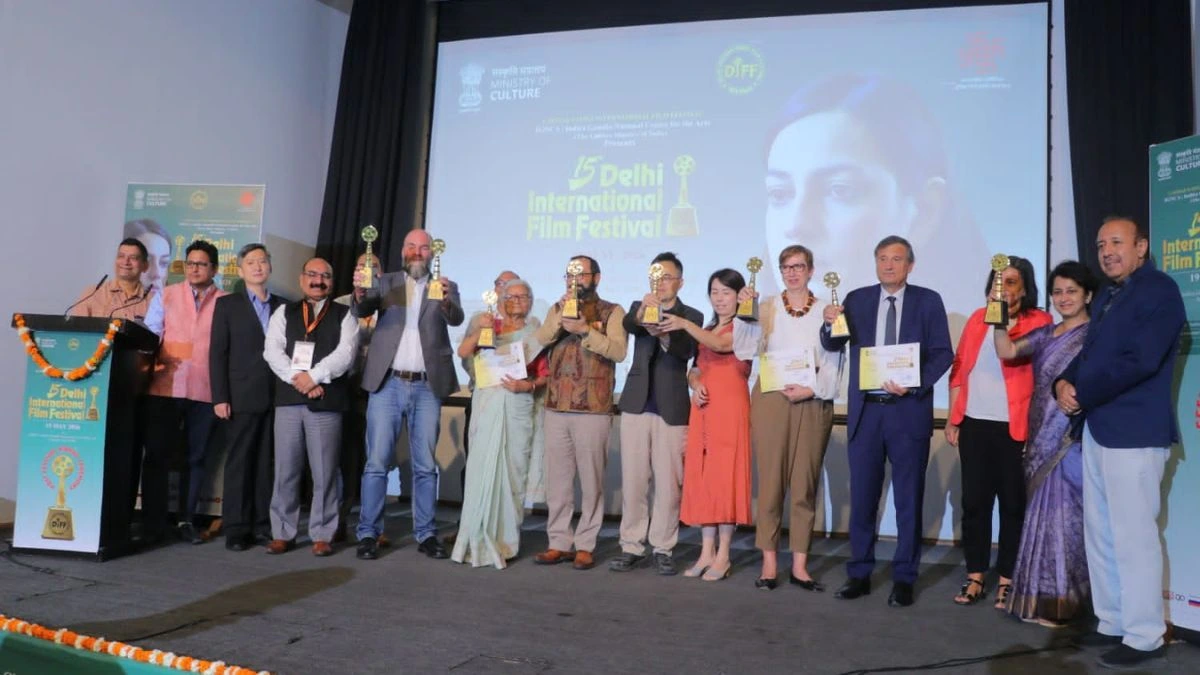
New Delhi: Amidst a confluence of art, diplomacy, and global narratives, a remarkably grand and exclusive ‘Post-Festival Awards Event’ was successfully organized as part of the 15th Delhi International Film Festival (DIFF) at the Indira Gandhi National Centre for the Arts (IGNCA) in the national capital, New Delhi.
Organized with the support of the Ministry of Culture and in special partnership with the Indira Gandhi National Centre for the Arts (IGNCA), this festival provided a fresh platform for world cinema, showcasing 178 films from 51 different countries.
The highlight of this magnificent ceremony was the fact that, amidst established cinematic nations, films from countries such as Iran, Algeria, Bulgaria, and Latvia took everyone by surprise; with their exceptional storytelling, sensitive social themes, and high technical standards, they dominated the proceedings and clinched the top awards.
During the awards distribution, the Short Film category revealed unexpected and astounding international talent. The Algerian short film Damou Ki—directed by the gifted filmmaker Youcef Ben Ghanem—astonished everyone with its profound narrative, earning the film the ‘Best Actress’ award. This honor was received on stage by His Excellency Ali Achoui (Ambassador of Algeria), First Secretary Abdelali Bouilota, Attaché Abdesselem Benarba, and Mrs. Asma Benarba.
Meanwhile, Director Hossein Firouzeh’s highly acclaimed Kurdish-Persian film Happy End received the ‘Best Short Film’ award, which was accepted by Mr. Omid Babelian, Second Secretary at the Iranian Embassy. Additionally, the work of director Abhay Kapoor on the Hindi short film ‘Gaiya’ was lauded, receiving special commendation in the distinguished presence of Mr. Anurag Punetha, Media Controller at the Indira Gandhi National Centre for the Arts.
In the International and Indian Cinema Awards category, the cinema of Latvia and Bulgaria proved particularly impressive; the Latvian film ‘Little Anna’ astonished everyone with its profound social relevance, earning its director, Uldis Gabriel Sipsnats, the award for Best Social Film—an honor accepted by Ms. Inga Skruzmane, Chargé d’Affaires and Deputy Head of Mission at the Embassy of Latvia.
Bulgarian cinema, surprising all with its diversity and technical prowess, claimed two major trophies: in the presence of His Excellency Ambassador Nikolay Yankov, ‘To Put It Mildly’ received the award for Best Animation Film, while ‘Anna’ was bestowed the prestigious honor of Best Feature Film in World Cinema.
Similarly, for the Bangladeshi film ‘Manusher Bagan’, director Nurul Alam Atique was presented with the award for Best Feature Film on a Social Subject on stage, in the presence of His Excellency M. Riaz Hamidullah and Ms. Samia Israt Roni from the High Commission of Bangladesh.
Russian cinema also maintained a strong presence, with Daria Gavrushina receiving the award for Best Russian Actress for ‘Horn and Ivory’, and the film ‘The Blind’—directed by Ilyas Daudi—receiving the Jury’s Choice Award, which was accepted by Mr. Petr Sizov, Press Secretary at the Embassy of Russia. Finally, the film ‘The Ballad of Piargy’ by Slovak director Ivo Trajkov received the award for Best Historical Feature Film, an achievement celebrated in the presence of the Slovak Ambassador, His Excellency Robert Maxian.
In the category of Indian Regional Cinema, Sushila Rawat was bestowed with the prestigious honor of ‘Best Woman Director’ for the Garhwali film Ghangtaul, presented in the presence of His Excellency Ali Achoui, the Ambassador of Algeria, and Mr. Sanjay Joshi.
Additionally, the Indian music video Land of Others was honored, and the award for ‘Best Supporting Actress’ was presented for the Malayalam film Jangar. During the cultural segment of the ceremony, Dr. Sushil Jain and Gurvinder Gallu mesmerized the audience with a melodious mandolin duet.
In the concluding session, the festival’s founder, Ramkishore Parcha, extended his gratitude to all the global diplomats—including New Zealand’s Deputy High Commissioner Matthew Ayres, Switzerland’s Chargé d’Affaires Simon Sevan Schäfer, and officials from the North Korean Embassy (Counselor Jang Jong Hwan and First Secretary Kim Myong Chol)—as well as to the art enthusiasts and jury members, Arvind Gaur and O.P. Mishra. This was followed by the screening of a magnificent ‘India Gate Montage’ on the screen.
The Delhi International Film Festival (DIFF) stands as a prestigious and leading global cinematic platform in the national capital, founded by the renowned filmmaker and writer Ramkishore Parcha. Every year, the festival brings a selection of the world’s finest feature films, documentaries, and short films to the audiences of Delhi.
This year, stories from Chinese, Russian, and African cinema were placed under a ‘Special Focus’ category, where they demonstrated their cinematic excellence. The ceremony commenced with a moment of great pride on stage, witnessed by all the global ambassadors and distinguished guests present, as the Kavita Sangrah (Trilogy Poetry Collection)—authored by the festival’s founder, Ramkishore Parcha—was grandly unveiled. This collection comprises three prominent volumes titled Tum, Barf Par Titli, and Tumhara Naam Nadi.
Immediately following this, a special medal distribution ceremony was organized for the diligent core team members who, working behind the scenes, played a pivotal role in making the festival a historic success. During this ceremony, members of the Chinese delegation presented medals to honor Rajan Jhanji, Pramod Kaunswal, Usha Pahwa, Anishka Kishore, Aradhya, Rajiv Ranjan, Prashant, Manvendra Ji, and Narendra Singh.
Continuing in this vein, Dr. Ranjan Mallick—an eminent artist and the Dean and Head of the Department of Fine Arts at Chitkara University—was specially felicitated on stage for his artistic contributions and was presented with a DIFF Art Show certification and a trophy.
Finally, formal expressions of gratitude were extended to all collaborators—including Ram Bahadur Rai (Chairman, IGNCA), Dr. Sachchidanand Joshi (Secretary), and Anurag Punetha (Media Controller)—on behalf of the Ministry of Culture. As the grand finale of this successful post-awards ceremony, a special closing screening of the award-winning Garhwali feature film Ghangtaul was held for the audience.
Next year, the festival is scheduled to be held at the Indira Gandhi National Centre for the Arts (IGNCA) from February 15th to 19th.


