
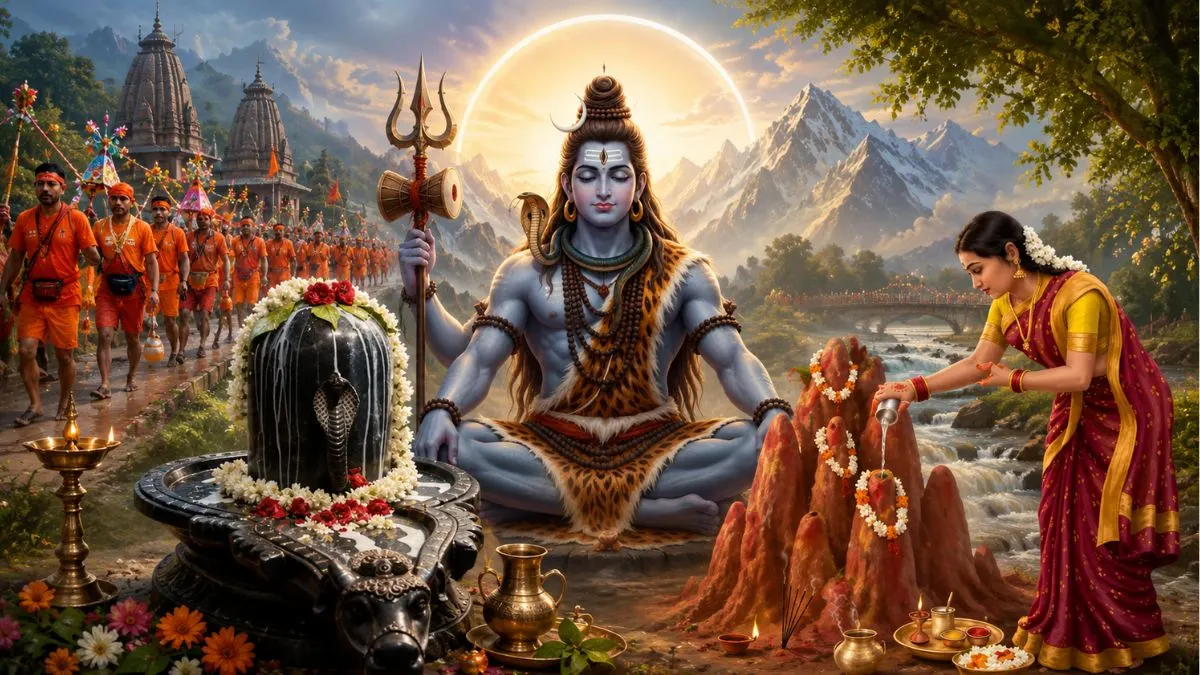
When does Sawan 2026 start and end? Dates for North and South India, Monday fasts, Mangala Gauri Vrat, Nag Panchami, Raksha Bandhan, Kanwar Yatra, and the meaning behind every offering made to Lord Shiva — find out all the details here.
New Delhi: Among the twelve months of the Hindu calendar, Sawan (Shravan) holds a special place of its own. This fifth month falls during the monsoon season and is considered the most sacred time for worshipping Lord Shiva. Throughout this period, the ringing of temple bells, chants of “Bam Bam Bhole,” and processions of kanwariyas fill the atmosphere with devotion.
The roots of this month trace back to the mythological tale of the Samudra Manthan, when gods and demons together churned the ocean. The poison that emerged from that churning, known as Halahal, was so lethal that it threatened all of creation. To protect the world, Lord Shiva held that poison in his throat, which turned blue as a result — earning him the name Neelkanth. It is believed that the rains of Sawan cool the heat of that very poison, which is why this month carries the tradition of performing abhishek on the Shivling with water and milk.
Interestingly, the dates of Sawan are not the same across all of India. This is due to two different methods of calendar calculation: Purnimant and Amant.
Purnimanta vs. Amanta: Why the Difference in Dates?
Most states in North India follow the Purnimanta calendar, in which the month ends on the night of the full moon (Purnima). Meanwhile, many states in South and West India follow the Amanta calendar, where the month ends on the new moon (Amavasya). Both systems count the same lunar cycle but from different starting points, which is why there is roughly a fifteen-day gap between the Sawan dates observed in these two regions.
Sawan 2026: Start and End Dates
North India (states such as Uttar Pradesh, Bihar, Uttarakhand, Madhya Pradesh, Rajasthan, Delhi, and Punjab, which follow the Purnimanta calendar): Sawan will begin on Thursday, July 30, 2026, and end on Friday, August 28, 2026, on Shravan Purnima.
South and West India (states such as Maharashtra, Gujarat, Karnataka, Tamil Nadu, Andhra Pradesh, Telangana, and Goa, which follow the Amanta calendar): Shravan month here will begin on Thursday, August 13, 2026, and run until approximately Friday, September 11, 2026.
If you live outside India or are uncertain about which tradition your region follows, it is best to confirm with your local panchang or a priest, since the exact timings can vary slightly by location.
Sawan Mondays 2026: The Most Beloved Fast Among Shiva Devotees
Observing a fast on every Monday of Sawan is the most popular tradition of this month. It is believed that fasting on this day and offering water or milk to the Shivling helps fulfill one’s wishes.
According to the North Indian calendar, the four Sawan Mondays in 2026 are:
- August 3
- August 10
- August 17
- August 24
In South and West India, these Mondays fall about two weeks later — on August 17, 24, 31, and September 7.
Those observing the fast typically avoid grains and sustain themselves on fruits or milk during the day. In the evening, they eat a sattvic meal and perform Shiva puja, chanting “Om Namah Shivaya” or the Mahamrityunjaya mantra. Unmarried women who wish for a good life partner often begin the Solah Somvar Vrat (16 Monday fasts) starting from the first Monday of this month.
Mangala Gauri Vrat: A Special Ritual for Married Women
On every Tuesday of Sawan, married women observe the Mangala Gauri Vrat. This fast is dedicated to Goddess Parvati (Gauri) and is performed for the long life of one’s husband, marital happiness, and family prosperity.
According to the North Indian calendar, the Mangala Gauri Vrat dates in 2026 are:
- August 4
- August 11
- August 18
- August 25
On this day, along with fasting, women perform puja to Goddess Gauri with specific offerings and listen to the vrat katha (fasting story), which is considered auspicious for family well-being and prosperity.
Nag Panchami: The Day of Worshipping Serpent Deities
Nag Panchami also holds special significance during Sawan. In 2026, this festival is likely to fall on either August 16 or 17 (Sunday or Monday); the exact date will depend on the panchang followed in your region. On this day, Naga deities are worshipped, given their deep association with Shiva, who wears a serpent around his neck. Devotees offer milk, flowers, and other items to snake idols or anthills. As per tradition, digging the earth or harming snakes is avoided on this day.
Raksha Bandhan: A Festival of Sibling Love
Raksha Bandhan in 2026 will be celebrated on Friday, August 28, which coincides with the end of Sawan in North India — Shravan Purnima. On this day, sisters tie a rakhi (sacred thread) on their brothers’ wrists, wishing them a long life and protection. It is also an occasion for family bonding and celebration.
Do’s and Don’ts During Sawan
The month of Sawan is regarded as a time for a pure and disciplined lifestyle. Some key points:
Do’s:
- Perform daily Shiva puja and abhishek, especially on Mondays
- Offer bel patra, Ganga jal, milk, and water
- Chant Shiva mantras
- Observe the Monday fast or Mangala Gauri Vrat
- Eat sattvic, pure vegetarian food
- Practice cleanliness, charity, and compassion
- Wear rudraksha and visit Shiva temples
- Participate in the Kanwar Yatra if inclined
Don’ts:
- Avoid non-vegetarian food, alcohol, and tamasic items like onion and garlic
- In some traditions, cutting hair or nails is avoided
- Avoid anger, harsh words, or harming any creature (especially snakes)
- Those following strict rules avoid certain leafy vegetables or brinjal
- Stay away from excessive indulgence or impure thoughts
It’s also worth noting that digestion naturally weakens during the monsoon season, which is why avoiding heavy and spicy food is advised for practical reasons as well.
One Faith, Many Traditions: Sawan Across India’s States
While the core spirit of devotion to Shiva remains the same, the way Sawan is celebrated varies slightly from state to state:
- Uttar Pradesh and Bihar: Enthusiasm for the Kanwar Yatra reaches its peak here, with large crowds of devotees thronging major Shiva temples like those in Varanasi.
- Uttarakhand: Places like Haridwar and Gangotri serve as the sources of major Kanwar routes, with special arrangements made for the convenience of pilgrims.
- Maharashtra: Dates differ due to the Amanta calendar, but the tradition of fasting and temple rituals runs just as deep.
- Gujarat: The Amanta calendar applies here too, along with community worship and some unique local folk traditions.
- Madhya Pradesh: A blend of North Indian traditions and local Shiva temples defines the character of this state.
- Tamil Nadu and Karnataka: Dates fall later as per the Amanta calendar, with emphasis on temple abhishekam and bilva leaf offerings, though large-scale walking pilgrimages like the Kanwar Yatra are less common here.
Despite differences in dates and local flavors, devotion to Shiva, the monsoon timing, and shared rituals bind the entire country together.
Kanwar Yatra: Faith, Tradition, and Its Social Impact
- History: The roots of the Kanwar Yatra lie in the old tradition of carrying Ganga water on foot to perform Shiva’s abhishek. Evidence of this practice dates back to around the eighteenth century, when pilgrims traveled from Sultanganj to Deoghar (Baidyanath Dham). For a long time, it remained largely limited to ascetics and rural devotees, but from the late twentieth century onward, better roads, urban participation, and organized infrastructure caused its scale to grow manifold. Today, it is counted among India’s largest annual religious gatherings — in Haridwar alone, tens of millions of devotees have participated in recent years.
- Route: Kanwariyas (also called “Bhole”) mainly collect Ganga water from Haridwar, Gangotri, or Sultanganj in Bihar. They carry it in pots suspended from a bamboo kanwar, often barefoot and dressed in saffron, walking hundreds of kilometers to reach their local Shiva temple or major pilgrimage sites such as Baidyanath Dham and Kashi Vishwanath. Temporary camps are set up along national highways for rest, food, and medical assistance.
- Rituals: Collecting pure Ganga water, continuously chanting “Bol Bam,” following strict rules such as never setting the kanwar down on the ground mid-journey, and finally performing the abhishek of the Shivling — these form the core of the pilgrimage. Devotees typically travel in groups to support one another.
- Economic Activity: This pilgrimage significantly boosts local economies along the route through camps, food stalls, transportation, and temporary employment.
- Crowd Management: Governments in Uttarakhand, Uttar Pradesh, Bihar, and Delhi-NCR deploy heavy police forces, redirect traffic, set up temporary medical facilities, and run camps in coordination with voluntary organizations. With participation numbering in the tens of millions, this requires extensive planning.
- Environmental Concerns: Such massive crowds generate plastic waste, litter, and place pressure on water sources and roads. To address this, campaigns like “Eco-Kanwar” are being run, promoting the use of steel containers and reduced plastic use. Authorities and organizing bodies are gradually becoming more proactive on these issues.
Deep Meaning Behind Every Offering
The offerings made to Shiva during Sawan (and in general) carry deep mythological and practical meaning. The underlying sentiment is to soothe the “heat” that Shiva bears as a result of the Halahal poison.
- Bel Patra (Bilva leaf): This three-leaved offering is seen as a symbol of Shiva’s three eyes, the Trimurti (Brahma-Vishnu-Mahesh), and the three gunas (sattva-rajas-tamas). Offering it is regarded as surrendering one’s ego and the three aspects of body, mind, and intellect to Shiva. It is also said to have a cooling nature.
- Water: A symbol of purity and the washing away of sins; the general abhishek is performed in this spirit.
- Milk: A symbol of purity, nourishment, and coolness. In some traditions, it is also believed to soothe afflictions related to the Moon and Ketu.
- Honey: Symbolizes the sweetness of life, prosperity, and the removal of bitterness.
- Ganga Jal (Ganges water): A symbol of ultimate purity. It is believed to wash away sins, fulfill desires, and connect the devotee directly to the sacred Ganga, which flows from Shiva’s matted hair.
- Bhasma (sacred ash): A symbol of the transience of the world and renunciation. Shiva’s association with cremation grounds reflects this same spirit — wearing bhasma signifies detachment and purity.
- Rudraksha: Meaning “the tears of Rudra (Shiva),” wearing or offering it is considered a symbol of protection, spiritual connection, and mindful devotion. Different mukhi (faced) rudrakshas are said to carry their own significance.
- Datura: One of the items believed to be especially dear to Shiva. It is linked to his ascetic and fierce form and is seen as symbolizing the transformation of poison and an act of surrender.
- Bhang: In certain folk tales and traditions, this is associated with Shiva’s yogic form and the poison episode. Some devotees include it in a limited, symbolic way as part of their rituals, though this is not universally practiced.
Overall, all these offerings reflect a devotee’s desire for coolness, purity, surrender, and Shiva’s grace. Practices may vary slightly depending on the region, the temple priest, and an individual’s own capacity — but the true essence lies in sincere devotion rather than rigid rules.
The month of Sawan is not limited to fasting alone — it is a unique confluence of faith, discipline, and community. Whether you follow the North Indian tradition or the South Indian one, whether you observe the Monday fast or not, this month offers a good opportunity to practice a bit of self-discipline and seek inner peace. Always consult your local panchang or a trusted priest for the exact dates and timings in your region, as personal circumstances (such as health) can also affect fasting rules.