
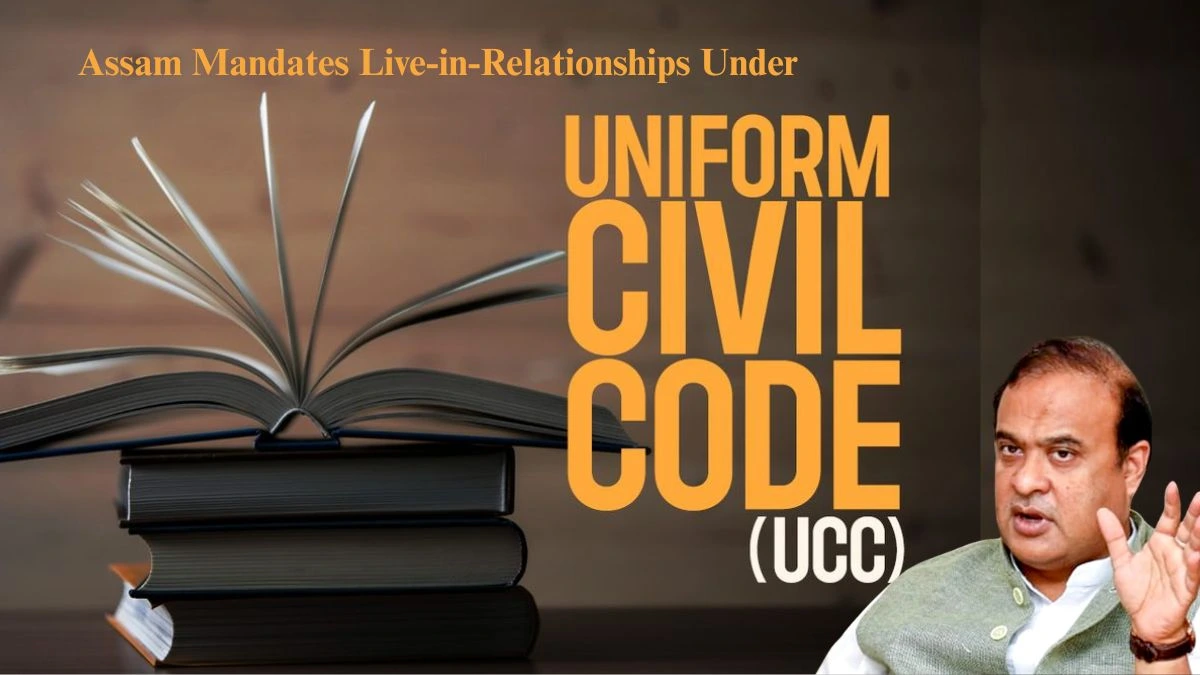
Assam has become the third Indian state to pass a Uniform Civil Code (UCC) Bill. The new law makes it compulsory to register live-in relationships, bans polygamy, and sets uniform rules for marriage, divorce, and inheritance for all residents
New Delhi/Assam: In a significant legislative move, the Assam Legislative Assembly today passed the Uniform Civil Code (UCC) Bill, 2026, making the state the third in India after Uttarakhand (which was the first, in February 2024) and Gujarat (which passed its UCC in March 2026 after a seven-hour debate), to adopt a comprehensive uniform civil law. One of the most discussed provisions of the new legislation is the mandatory registration of live-in relationships.
What Is the UCC?
Right now, different communities in India follow different personal laws. Like rules around marriage, divorce, or inheritance can vary depending on whether someone is Hindu, Muslim, Christian, or follows tribal customs. A Uniform Civil Code replaces all of that with one standard law for everyone in the state.
The core goal, as stated in the Bill itself, is to “consolidate and simplify laws governing marriage, divorce, succession and live-in relationships” across all communities.
Compulsory registration of Live-in Relationships
The most talked-about part of the Assam UCC Bill is the mandatory registration of live-in relationships. This is new, and here’s what it means in plain language:
Under the Assam UCC Bill 2026, all couples in a live-in relationship are required to register their relationship with the Sub-Registrar within 30 days of entering into it. This applies to:
Residents of Assam, even if they are currently living outside the state.
Both partners must jointly submit a declaration/statement regarding their relationship.
The government has described this move as a significant step toward providing legal recognition and protection to individuals, particularly women, in live-in relationships.
Why is the government doing this?
The Assam government says this is about protecting people — especially women and children. Here’s the reasoning behind each benefit:
- Legal Recognition
Once registered, the relationship is officially on record. This gives it a legal status that can be referred to in any future dispute. - Protection for Children
Any child born to a couple in a registered live-in relationship will be considered legally legitimate — meaning they will have full legal rights to their parents’ property and support, just like children born in a marriage. - Right to Maintenance
If one partner walks out or abandons the other, the deserted partner can go to court and ask for financial support (maintenance). The registration record becomes key proof in such cases. - Reducing Exploitation and Fraud
Cases where one partner (often the woman) is abandoned after years in a relationship, with no legal recourse, have been a persistent problem. Registration creates accountability and a paper trail, making it harder to simply walk away.
Also Read: Menstrual Hygiene Day: India’s Shift Toward Openness and Awareness
Who can register and who cannot?
Not every couple qualifies. Registration will be rejected or disallowed in the following situations:
- Either partner is below 18 years of age (a minor).
- One or both partners are already married or are in another live-in relationship.
- The couple falls within prohibited degrees of relationship — meaning they are too closely related by blood (incestuous relationships).
- Consent was obtained through force, coercion, or deception/fraud.
Additionally, in cases where one or both partners are younger adults (though not minors), the registrar may inform their parents or involve police.
What happens if you don’t register?
The law takes non-compliance seriously. Here are the penalties:
| Violation | Penalty |
|---|---|
| Not registering within 30 days | Imprisonment up to 3 months, or fine up to ₹10,000, or both |
| Providing false or misleading information | Imprisonment up to 3 months and fine up to ₹25,000 |
| Repeated violations or formal complaints | Higher penalties may apply |
Also important: If a couple decides to end their live-in relationship, they must also give a formal notice of termination through the same system.
Exemptions and detailed UCC framework
The UCC Bill exempts Scheduled Tribes (tribal communities) of Assam to respect their unique customs and traditions.
Beyond live-in relationships, the Bill also introduces:
- A complete ban on polygamy (with penalties up to 7 years imprisonment).
- Compulsory registration of all marriages and divorces.
- Uniform rules for inheritance, succession, and adoption.
- Minimum marriage age of 21 years for men and 18 years for women.
What do Assam’s Demographics look like?
Understanding the context helps. According to the 2011 Census:
Muslims make up approximately 34.22% of Assam’s population — one of the highest proportions in any Indian state.
Scheduled Tribes make up about 12.45% of the population, and are exempt from the UCC.
The UCC will apply to the remaining majority of the population, cutting across Hindu, Muslim, Christian, and other non-tribal communities.
The Bill was introduced on May 25 and passed today (27-05-2026) despite protests and demands for more consultation from opposition parties, including Congress. The Assam government, led by Chief Minister Himanta Biswa Sarma, has positioned the UCC as a progressive reform promoting gender justice and equality.
This provision brings live-in relationships — which have become increasingly common — under a formal legal framework for the first time in the state. While supporters hail it as a modern and protective measure, critics have raised concerns about privacy and implementation challenges.
The full Act is expected to be notified soon, after which detailed rules and procedures for registration will be issued.